
I love Brixton. I will never forget the first time I visited — the energy hit me before I could name it. The market, the sound coming out of every doorway, the way people moved and dressed and occupied the street. It reminded me of New York in the way that matters most: not architecturally, but spiritually. A place where Black people had made something unmistakably their own, and where that something had become the heartbeat of everything around it. I felt at home. What I did not fully understand at the time was how far along the cycle already was.
Brixton gave the world a sound. Hackney gave it an aesthetic. Peckham gave it a visual language. The specific character of London’s global cultural identity — the music, the fashion, the food, the particular cosmopolitan energy that has made the city a creative capital for decades — was not produced by the institutions that now benefit from it. It was produced by Black and Brown communities building culture in neighborhoods where rent was affordable and space was available and the city had not yet decided to pay attention. That is the pattern. The city ignores, the community builds, the city notices, the city monetizes, the community is displaced. London is currently in the monetization phase of a cycle that has been running for thirty years, and the communities that seeded it are running out of room.
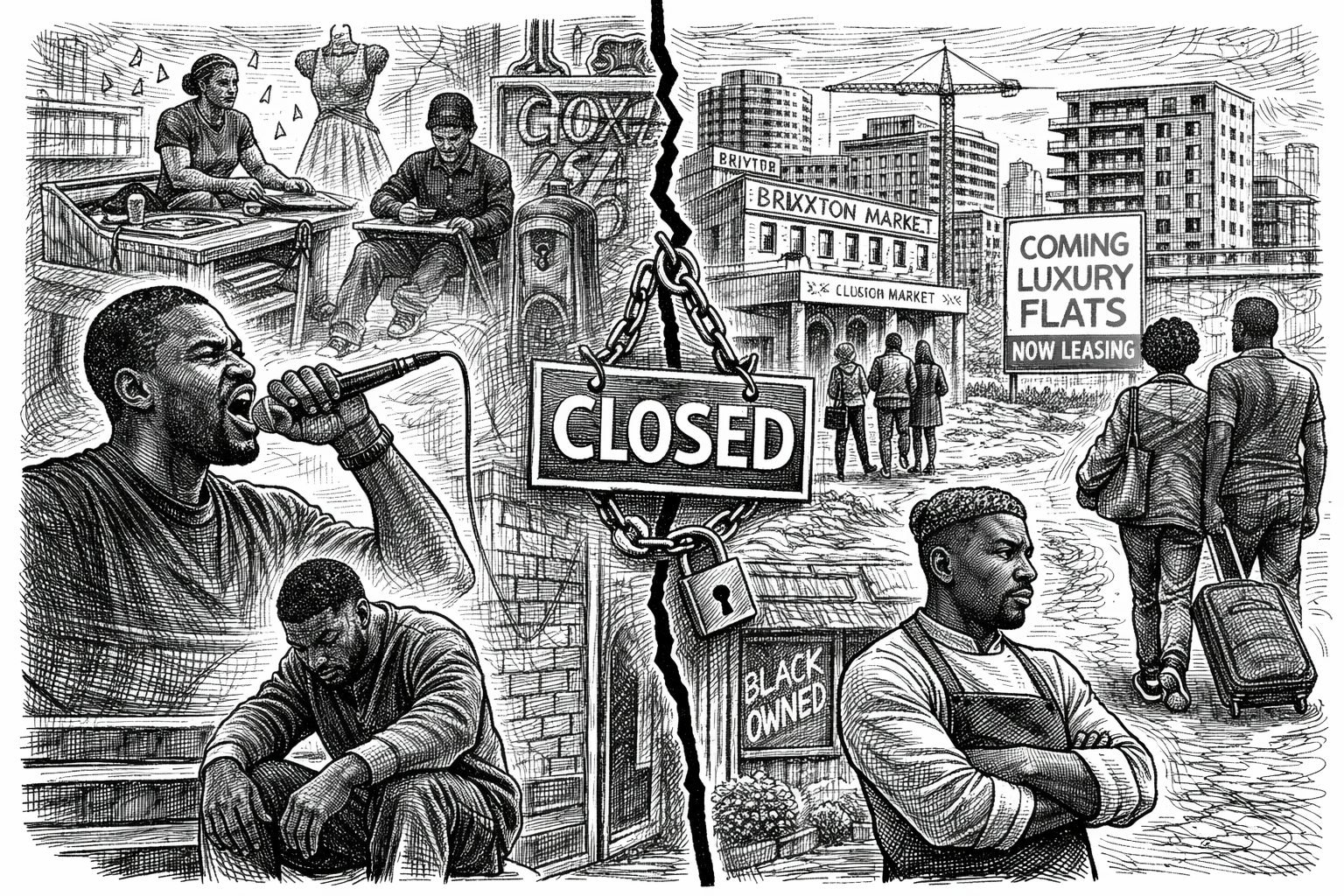
The numbers are concrete. Brixton, once the center of London’s Afro-Caribbean community and the origin point of musical and cultural movements that traveled globally, has seen average rents increase by more than 50 percent over the past decade. The Brixton Market — a cultural anchor for the West Indian community since the 1940s — has faced sustained pressure from developers and the borough council seeking to reposition the area for a higher-income demographic. Venue closures across South and East London have eliminated rehearsal spaces, performance venues, and cultural gathering points that once made London accessible to working-class Black artists. What is being lost is not simply affordability. It is the physical infrastructure that makes creative community possible — the places where collaboration happens before it becomes product, where culture forms before it becomes commodity.
This is not incidental to London’s economic development strategy. It is, in many ways, its product. The creative and cultural industries are among London’s largest economic sectors, generating billions in revenue and employing hundreds of thousands of people. But the value of those industries was seeded by communities that did not profit proportionally from its growth, and the development strategies that have reshaped inner London have consistently rewarded the extraction of that cultural value while pricing out the communities that generated it. The pattern mirrors what SSC has documented in American cities — the touring economy concentrating in high-income markets, the streaming economy redistributing cultural value upward, the real estate market translating neighborhood character into premium pricing while the communities that created that character are pushed outward. London is operating the same mechanism at a different scale and with a different colonial history, but the structural logic is identical.
What makes the London story urgent for SSC’s readership is the global dimension. The Black British creative economy — grime, Afrobeats UK, British drill, the fashion and visual art scenes emerging from South and East London — is internationally influential in ways that increasingly affect American music, fashion, and culture. The artists producing that work are navigating the same questions of ownership, credit, and access that Black American creators face domestically, compounded by immigration status, the cost of London living, and a British cultural establishment that has been slow to fund or institutionalize the communities it profits from. When those communities are displaced from the neighborhoods where the work was made, something changes in the work itself — it becomes harder to make, more expensive to sustain, and more vulnerable to being absorbed into a mainstream that will take the aesthetic while leaving the community behind.