
The restoration of the Pride flag at the Stonewall National Monument closes more than a legal dispute. It clarifies how public memory is being negotiated in real time. What appeared at first to be a quiet administrative removal by the Trump administration has been reframed through litigation, political pressure, and public response into something more consequential — a test of who gets to define history in shared civic space. The initial removal did not happen in isolation. It reflects a broader posture within the Trump administration where symbolic markers of identity and history are increasingly treated as optional rather than foundational. That distinction matters because Stonewall is not simply a landmark. It is one of the few federally recognized sites tied directly to LGBTQ+ resistance and organizing. Removing the Pride flag from that space was not a logistical decision. It signaled a narrowing of what is considered legitimate within the national narrative.
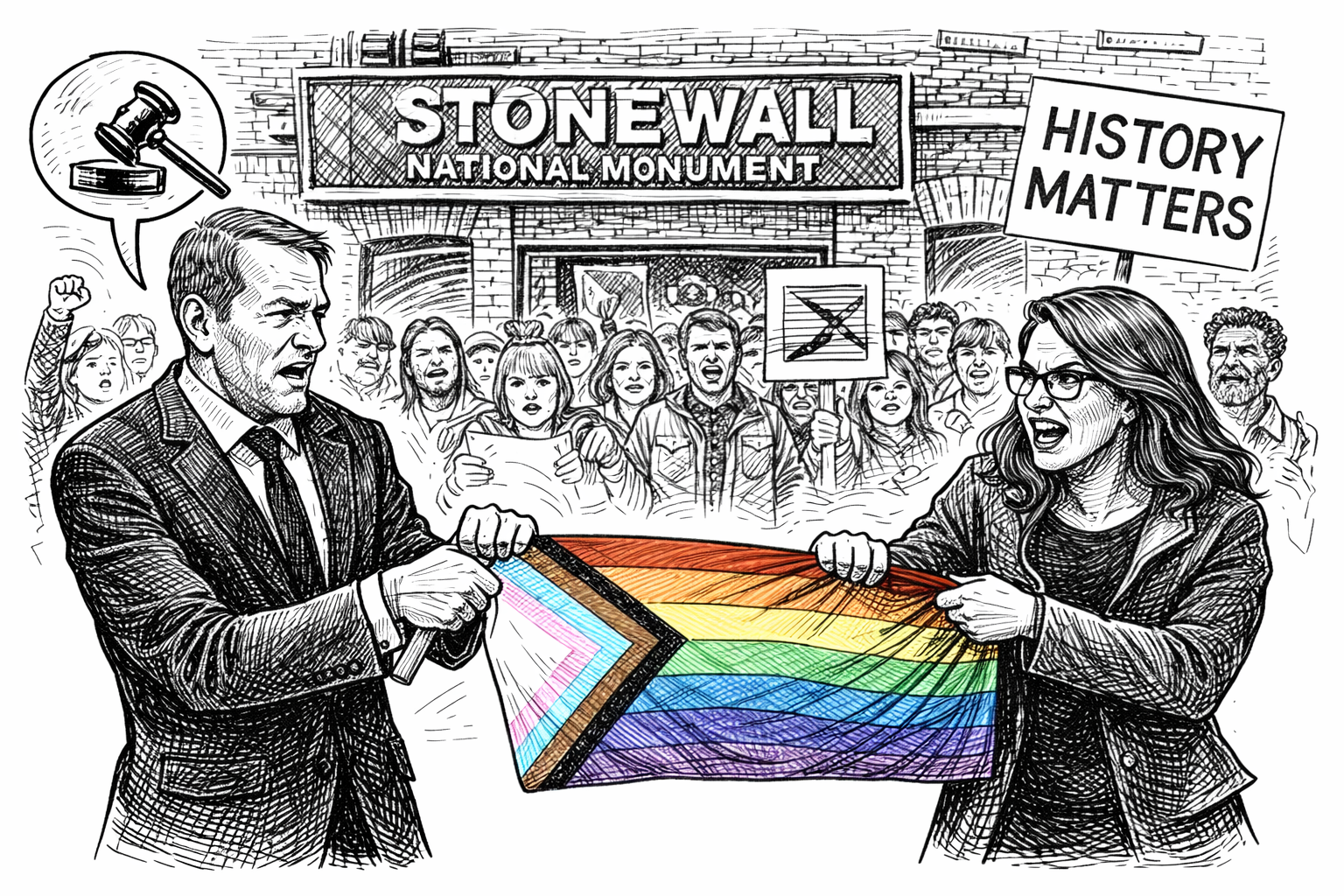
The legal challenge and subsequent settlement reveal how quickly that narrowing can be contested — and how much work is required to contest it. Advocacy groups, local officials, and sustained community pressure converged to force a reversal that should not have been necessary in the first place. Statements from Manhattan Borough President Brad Hoylman-Sigal and Mayor Zohran Mamdani frame the outcome not as a victory but as a correction, which is the more precise characterization. A victory implies the original position was ambiguous. A correction implies it was wrong. What remains unresolved is the underlying condition that produced the removal. If a federal administration can quietly strip a symbol from one of the most historically significant LGBTQ+ sites in the country and only restore it under legal pressure, recognition itself is conditional. The Pride flag’s return does not settle that instability. It exposes it.
What makes that instability worth examining beyond this single case is the pattern it belongs to. The Stonewall removal did not happen in a vacuum — it happened alongside the gutting of the Institute of Museum and Library Services, the termination of federal grants for exhibitions on enslaved people’s resistance, executive orders directing museums to remove what the administration has labeled divisive narratives, and the withdrawal of private funding from cultural institutions unwilling to risk federal scrutiny. These are not separate policy decisions operating independently. They are a coordinated narrowing of what gets recognized, preserved, and funded in American public life — applied simultaneously to LGBTQ+ history, Black history, Latinx history, and any cultural programming that centers communities the administration has chosen to position outside its definition of the national narrative.
The mechanism changes depending on the target. Sometimes it is a flag removal. Sometimes it is a terminated grant. Sometimes it is an executive order, a museum directive, or a corporation quietly withdrawing sponsorship to avoid federal attention. But the function is consistent — to make the presence of certain histories in public space conditional, contingent, and reversible. As SSC has reported in its coverage of federal museum funding cuts and the redefinition of DEI as discrimination, the institutions most vulnerable to this pressure are the ones that were already operating with the thinnest margins and the least political protection. The Stonewall restoration is a reminder that even when pressure produces a correction, the underlying condition that made the removal possible remains intact. Representation, even when codified, is only as durable as the systems willing to uphold it — and right now, those systems are being tested from the inside.