
A new paper titled The AI Layoff Trap, by researchers at the University of Pennsylvania and Boston University, lays out a dynamic that feels obvious once you hear it and unavoidable once you understand it. If companies replace workers with AI faster than the economy can absorb them elsewhere, they begin eroding the very consumer demand they depend on. Workers are not just labor. They are customers. Remove enough income from the system, and the system itself starts to contract.
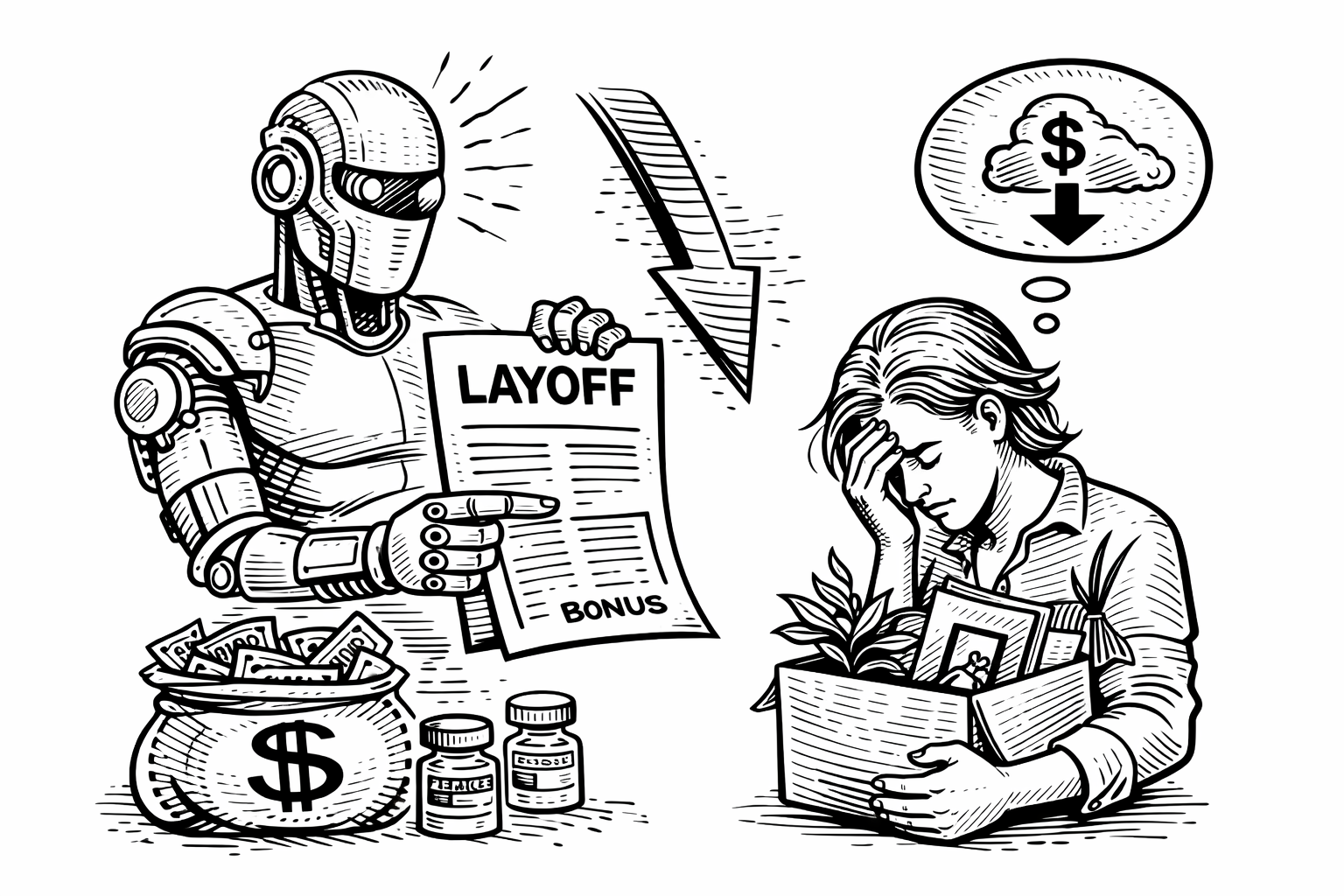
What makes the finding more unsettling is that the outcome is not driven by ignorance. The paper argues that firms can fully understand this dynamic and still move toward it anyway. In a competitive market, the decision is not made in isolation. If one company automates and cuts costs, its competitors are forced to follow or risk losing market share. What emerges is not a series of bad decisions but a rational cascade. Each individual move makes sense. Collectively, they produce something unstable.
This is the paper’s core argument: automation behaves like a Prisoner’s Dilemma. Every company would benefit from restraint at a system level, but no single company can afford to act on that restraint alone. The result is an arms race where firms continue displacing workers even as the long-term effect is a weaker customer base. The market does not correct the behavior because the incentives driving it are immediate, while the consequences are distributed and delayed.
The implications are already visible. Layoffs across the tech sector have accelerated, with AI increasingly cited as the driver. Companies are not just cutting costs — they are restructuring around the assumption that fewer human workers are needed at all. Productivity gains reinforce the logic: smaller teams produce more output, and from an individual firm’s vantage point, the math is clean. From a system perspective, it hollows out demand.
Many of the proposed solutions, the paper argues, do not reach the root. Universal basic income, reskilling programs, and profit-sharing may soften consequences, but they do not change the firm-level incentive to automate. As long as automation increases competitive advantage, companies will continue to pursue it regardless of what safety nets exist downstream.
The researchers point instead to a Pigouvian automation tax — a per-task charge applied each time a company replaces a human role with AI, forcing firms to price in the broader cost of lost income and eroded demand. The goal is not to stop automation but to correct the incentive distortion that drives over-automation. Without that mechanism, the model suggests the system continues moving in a direction that undermines itself.
The deeper pattern here extends beyond AI. Markets are often treated as self-correcting, but that assumption depends on incentives aligning with long-term stability. When they don’t, the system can move efficiently in the wrong direction. What this paper surfaces is that misalignment playing out in real time — technological progress and economic sustainability no longer moving together by default.
Companies will continue to automate. The question is whether the surrounding system adapts fast enough to absorb what that automation displaces. Because the risk is not only job loss. It is a structural weakening of the demand that makes the market function in the first place — and unlike previous technological disruptions, this one is accelerating faster than the corrective mechanisms designed to contain it.
The Critic’s Desk is SSC’s cultural criticism section. Coverage spans entertainment, media, identity, and the politics embedded in popular culture.