
The live music industry did not just recover from the pandemic. It restructured around it. What has returned is not the touring economy of 2019 — it is a hyper-scaled version of it, one in which the logic of scarcity, premium pricing, and market concentration has been applied to live performance in ways that are reshaping who participates and on what terms. Live music revenue reached approximately $31 billion globally in 2023, surpassing pre-pandemic levels and continuing to grow. That number is real. What it obscures is equally real: the growth is not evenly distributed across artists, venues, cities, or fans. It is concentrated at the top of every one of those categories simultaneously.
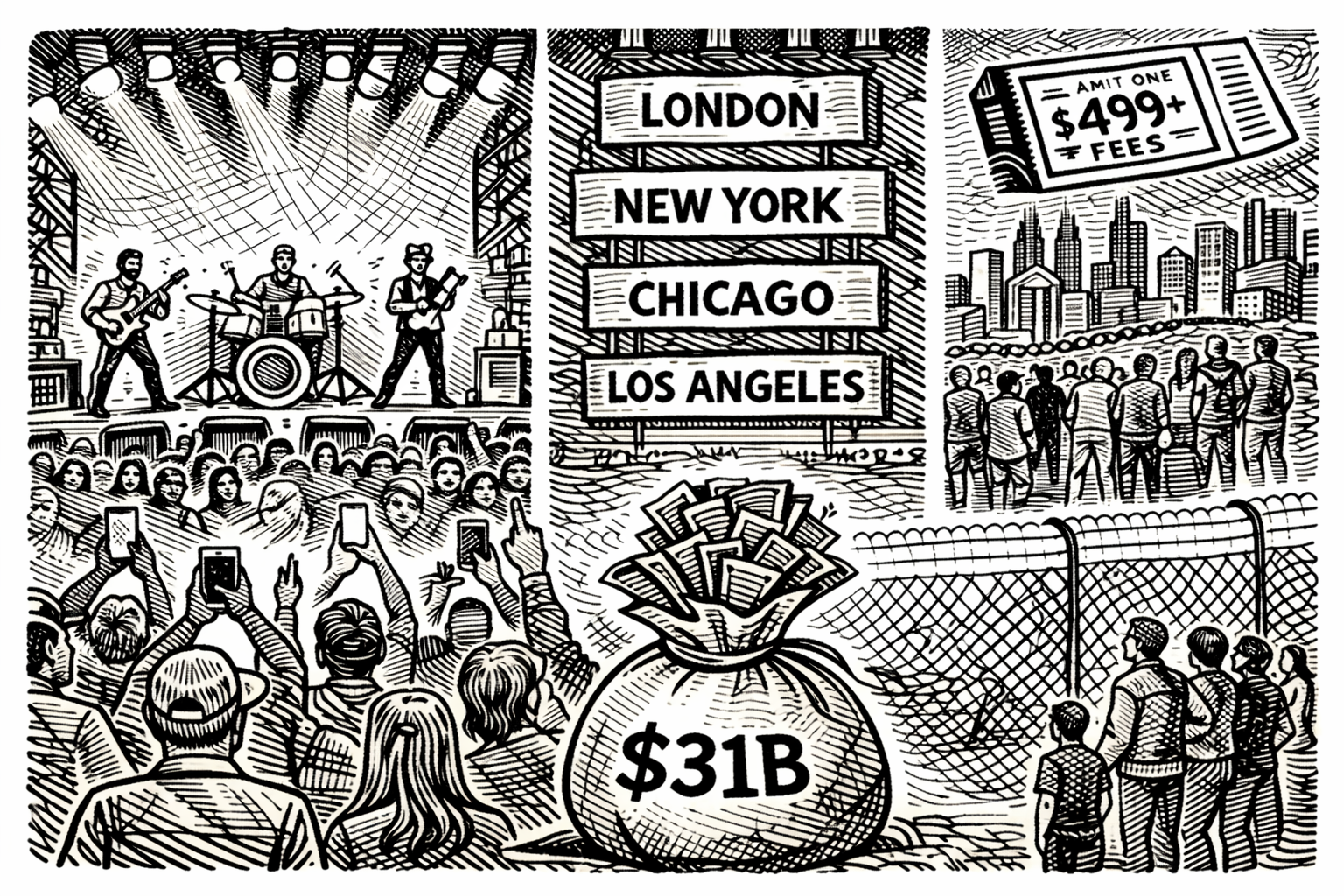
The economics driving the scale are not complicated. Streaming has effectively capped per-stream revenue for most artists at rates that make catalog volume and algorithmic placement the primary determinants of income — a structure that advantages established acts and disadvantages emerging and independent artists in compounding ways. As SSC reported in Independent Artists Are Breaking Through. Ownership Still Isn’t Catching Up., 77.8 percent of independent artists earned less than $15,000 from their music in 2025, and financial strain has replaced lack of exposure as the number one career roadblock. Against that backdrop, touring has become the primary revenue engine for artists who can sustain it — which means longer tours, larger venues, and more strategically curated city selections designed to maximize return per stop. The cities that make the cut — London, Chicago, Miami, Charlotte, Los Angeles, New York — are not chosen for their cultural significance alone. They are chosen because they have the ticket-buying power, venue infrastructure, and corporate sponsorship ecosystems that make a tour stop financially viable at scale. Cities that cannot meet that threshold get bypassed entirely, and the fans who live there are left to choose between absorbing the cost of travel, navigating secondary markets at significant markup, or accepting a digital substitute for an experience that is fundamentally physical.
That geography of exclusion is not random. It maps with uncomfortable precision onto existing patterns of economic inequality and racial segregation in American cities. The markets that anchor the touring circuit are largely the same markets that anchor luxury real estate, corporate headquarters, and premium consumer spending. The communities that fall outside that circuit — smaller cities, majority-Black and Brown metros without the venue infrastructure or corporate sponsorship base to attract major tours, rural areas with no realistic proximity to a major market — are the same communities that have been systematically underinvested in across every sector SSC covers. Live music access is not a frivolous amenity. It is a form of cultural participation, and its increasing concentration in a narrow set of high-income markets is a structural story, not a logistical one.
The pricing dimension compounds the geography problem. Average concert ticket prices have risen sharply in the post-pandemic period, driven by dynamic pricing models, platform fees, and the consolidation of the live events industry around a small number of dominant players. Ticketmaster’s merger with Live Nation — currently under active antitrust scrutiny — has given a single entity significant control over venue access, ticketing infrastructure, and artist management relationships simultaneously. That consolidation functions similarly to the vertical integration SSC has examined in healthcare, where a single company controlling multiple points in the value chain can shape access, pricing, and availability in ways that are difficult for consumers to navigate and nearly impossible to exit. The fan who wants to attend a major concert is not simply buying a ticket. They are entering a managed system that has priced its tiers carefully and designed friction into every exit point.
What the touring economy reveals, at scale, is the same pattern that appears across every sector where scarcity has been manufactured around a product that was once more broadly accessible. Live music used to be a community experience available across a wide range of price points and geographies. It is becoming a premium experience available primarily to those with the income to absorb dynamic pricing, the proximity to live in a tier-one market, and the flexibility to plan around tour schedules that favor weeknight shows in expensive cities. The $31 billion revenue figure is a measure of the industry’s recovery. It is not a measure of access. And in the gap between those two things, the touring economy is telling the same story every other restructured industry is telling — that the system is working exactly as designed, for exactly the people it was designed to serve.