
The modern healthcare experience is often described as fragmented. Different providers, separate systems, disconnected data. For years, that fragmentation has been framed as the core problem to solve, and companies like CVS Health have positioned themselves as the solution. What they’ve built instead is something more complex: a closed loop.
CVS now operates across nearly every layer of the healthcare system. Through its ownership of Aetna, it controls insurance coverage for more than 37 million members. Through Caremark, it manages prescription drug benefits for over 100 million plan members. Its retail pharmacies fill those prescriptions. Its MinuteClinics and Oak Street Health primary care centers deliver the care. The result is a single company positioned to influence how care is accessed, delivered, and paid for — from the moment a patient is diagnosed to the moment they pick up their medication. This structure is described as integration. In practice, it operates more like routing.
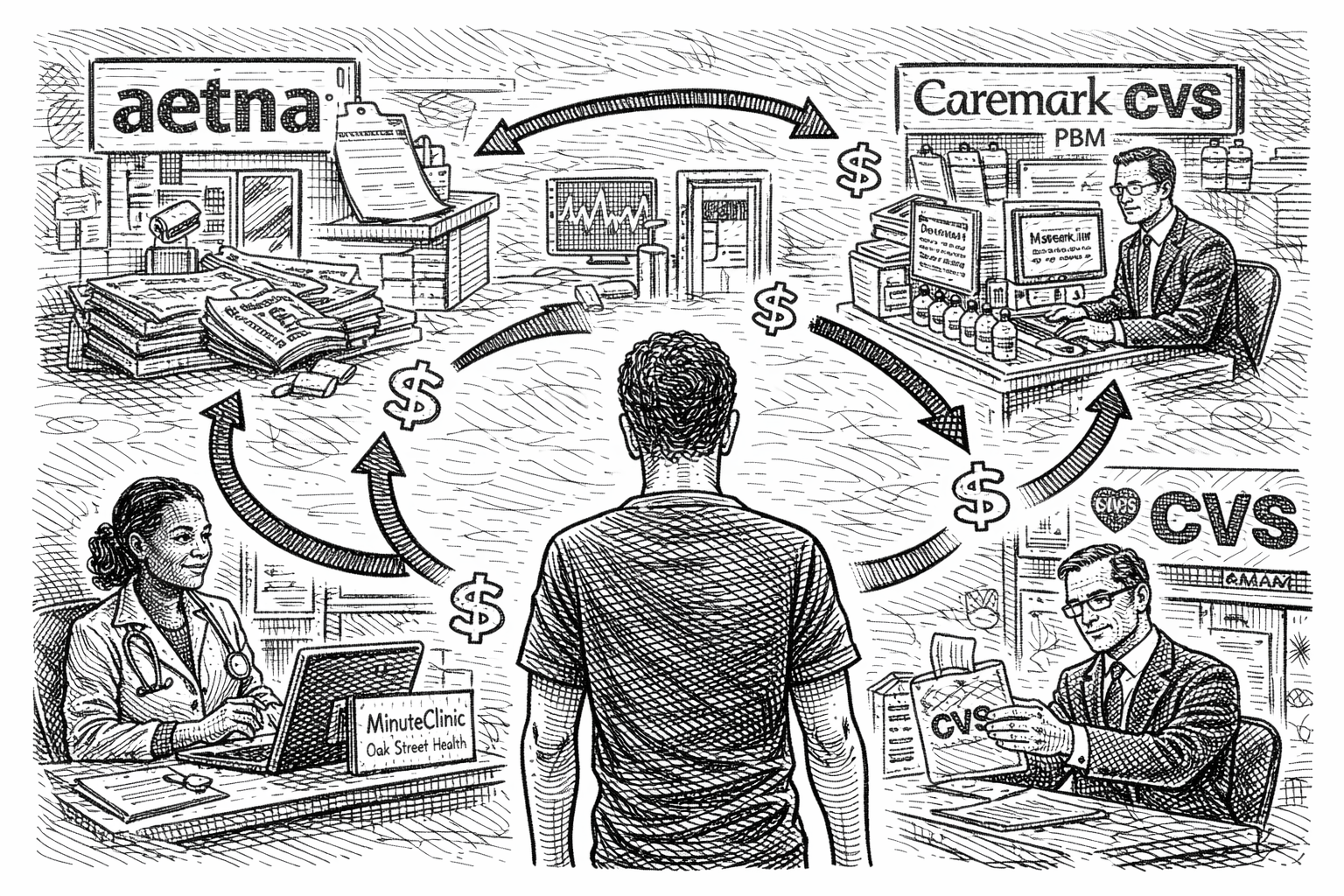
Patients are not forced into CVS-owned services. The system is designed so that staying inside is easier, faster, and cheaper. Aetna plans frequently incentivize or require the use of CVS pharmacies. Caremark’s benefit management can restrict where medications are filled. In-network clinics align with the same ecosystem managing coverage and cost. The architecture is not coercive. It is gravitational. Choice still exists, but it becomes increasingly conditional — and conditionality, compounded across every touchpoint of a patient’s care, is how a closed loop closes.
The economic logic is straightforward. When one company controls multiple points in the value chain, it can reduce leakage. A prescription written within the system gets filled within the system. A patient insured within the system receives care within the system. Each interaction reinforces the next. Revenue that might have been distributed across independent providers, community pharmacies, and regional health systems is retained internally. CVS reported $357 billion in revenue in 2023 — a number that reflects not just scale but the compounding effect of controlling multiple margins simultaneously. What makes this model powerful is not size alone, but continuity. Healthcare decisions are not one-time transactions. They are ongoing, recurring, and frequently guided by cost signals that patients do not fully control. When those signals are aligned across insurance, pharmacy, and care delivery by the same parent company, they create a path of least resistance that is structurally difficult to exit.
Departure is not prohibited, but it comes with friction. Higher out-of-pocket costs. Restricted coverage. Additional steps. Less convenience. Individually, each barrier is explainable. Collectively, they form a pressure system — one that does not deny access so much as price it differently depending on which direction you move.
Supporters of this model point to genuine benefits. Integrated systems can reduce administrative waste, improve medication adherence, and create more consistent patient data across care settings. The argument is that coordination at scale produces better outcomes and lower costs for patients who stay within it. Critics focus on where those efficiencies concentrate power. Pharmacy benefit managers like Caremark have faced sustained scrutiny over pricing opacity, rebate structures that disadvantage independent competitors, and formulary designs that steer patients toward preferred medications regardless of clinical necessity. Independent pharmacies have argued for years that vertically integrated competitors can tilt plan design against them in ways that are difficult to prove and harder to regulate. The Federal Trade Commission has taken increased interest in PBM practices, releasing a report in 2024 detailing how the three largest PBMs — including Caremark — used their market position to inflate drug costs while extracting value from independent pharmacies.
What is being built is not just a healthcare company but an environment — one where access is not simply granted or denied but shaped by benefit design, network construction, and the quiet alignment of financial incentives across entities that present themselves as separate but answer to the same balance sheet. The question is no longer whether healthcare will become more integrated. That shift is well underway, and CVS is not alone in making it. UnitedHealth Group has built a comparable structure through Optum, and Cigna operates a similar model through Express Scripts. The question is who controls the pathways — and whether patients, independent providers, and regulators can see clearly enough inside the loop to know what they’re actually navigating.