
Part of Culture in Motion — examining who defines culture, how it moves, and what it reveals about the moment.
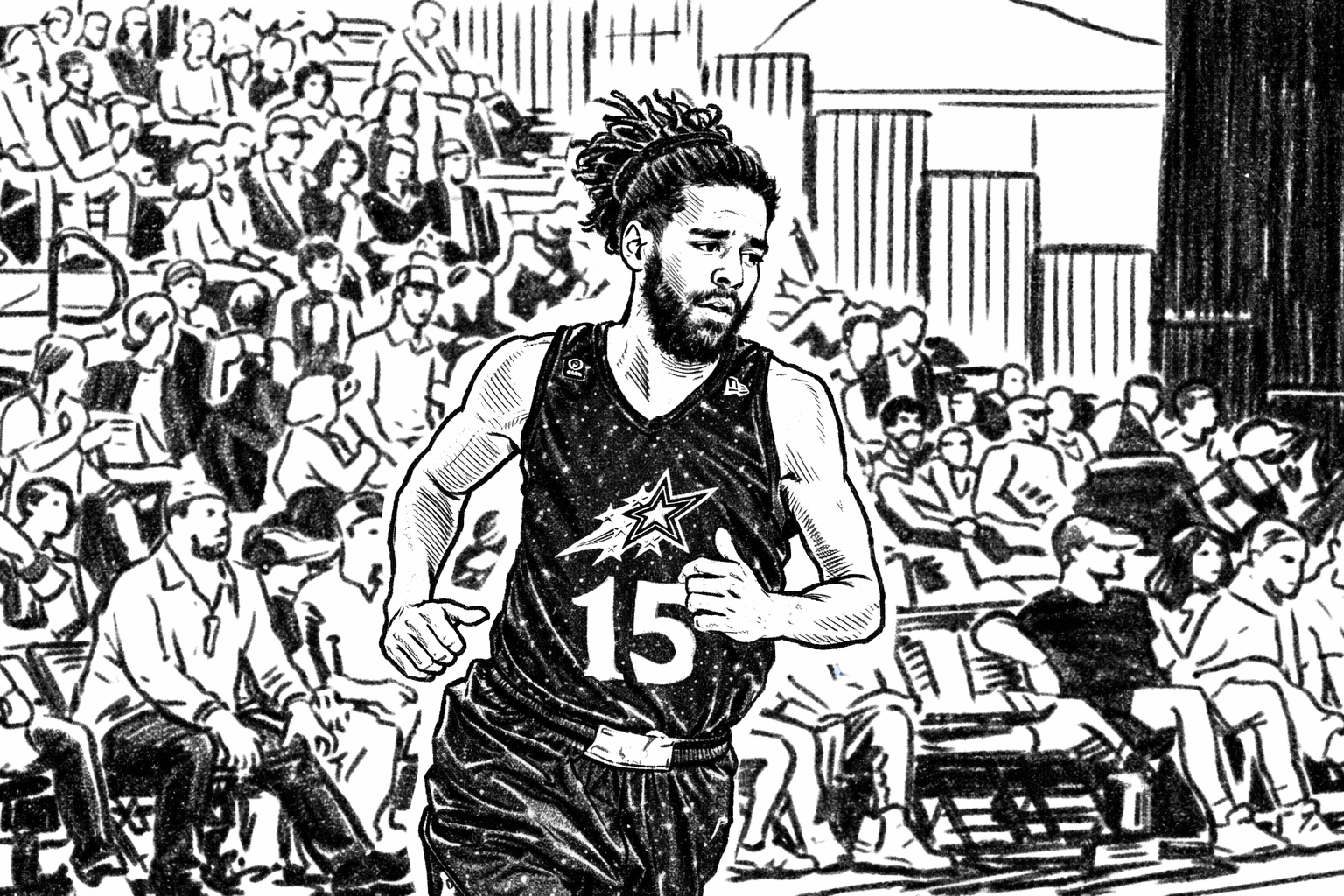
J. Cole signing with the Nanjing Monkey Kings is being treated like a curiosity. A rapper playing professional basketball again. A passion project extended just far enough to be taken seriously, but not far enough to be reclassified. That framing misses what is actually happening — and more importantly, it misses why it keeps happening.
This is not about access. It is about repetition. Cole has now played across multiple professional environments — the Basketball Africa League, Canada’s pro circuit, and now China’s professional league — with the same underlying pattern each time. He trains. He earns a roster spot. He competes. And then he does it again somewhere else. At a certain point, repetition stops reading as novelty and starts reading as structure. Structure is not a phase. It is a practice. And practices, sustained over time, become identities whether or not we are ready to name them.
What this disrupts is a long-standing expectation — one with specific historical roots that are worth naming rather than leaving implied. Black entertainers in particular have historically been confined to a primary lane, not simply by cultural preference but by institutional design. The music industry, the sports world, Hollywood — each has functioned as a separate ecosystem with its own gatekeepers, its own definitions of legitimacy, and its own tolerance for movement across categories. Excellence was permitted, even celebrated, but it was expected to remain contained. The athlete who wanted to rap was a distraction. The rapper who wanted to act was overreaching. The entertainer who wanted to be taken seriously in any domain outside their designated one was, at minimum, unfocused — and at maximum, threatening to an industry logic built on predictability and control. That expectation was not neutral. It was a structure, and it served the people who benefited from keeping Black talent categorized and manageable.
Cole’s approach does not ask permission from that framework. He does not announce a transition or attempt to rebrand himself as something new. He does not seek validation from the institutions that would prefer to keep him in one lane. He simply continues to show up in a second discipline with enough consistency that the category itself begins to feel insufficient. The question quietly shifts from why is he doing this to why do we expect him not to — and that shift is the disruption. Not the signing. Not the jersey. The expectation that gets quietly retired every time he laces up somewhere new.
This is a pattern that extends beyond the court. As SSC examined in the Kendrick response piece, Cole has demonstrated a willingness to step outside what the culture demands of him at the exact moment the demand is loudest — whether that means pulling a diss record at Dreamville Festival because it no longer aligned with who he is, or showing up in a professional basketball league in China because the discipline is real to him regardless of how it is received. The thread running through both moments is the same: a consistent refusal to perform a version of himself that the audience finds more legible than the one that is actually true.
There is also a credibility test embedded in what he is doing that cannot be dismissed. Professional sports, even outside the NBA, are not symbolic spaces. They are environments governed by performance standards, conditioning requirements, systems knowledge, and the ability to function within a team structure where results have real consequences. The fact that Cole continues to be rostered — in multiple leagues, across multiple seasons — means he is meeting a threshold that cannot be manufactured through celebrity alone. Coaches do not keep players on rosters as a courtesy to their fan bases. He is there because he can play well enough to be there. That fact does more analytical work than any press release could.
What emerges from the pattern Cole is building is not a story about crossover appeal or the celebrity athlete novelty cycle. It is a story about the erosion of single-definition careers as the primary framework through which we understand professional identity. The modern public figure is increasingly operating as a portfolio rather than a title — a collection of sustained disciplines rather than a singular designation. Music can exist alongside sport. Creative work can exist alongside physical rigor. The idea that one must delegitimize the other is starting to feel less like a cultural norm and more like a legacy assumption that fewer and fewer people are willing to enforce.
This is where the story becomes less about Cole specifically and more about the model he is quietly reinforcing through repetition. When someone with his level of visibility — one of the most commercially and critically successful rappers of his generation — treats multiple disciplines as equally real and equally deserving of serious effort, it expands what becomes imaginable for others. Not in theory. In practice. The barrier stops being framed as talent alone. It gets reframed as time, access, and sustained commitment — variables that are controllable, not fixed. That reframing has consequence beyond basketball courts and recording studios. It is a different way of understanding what a life built around multiple serious pursuits can look like, and who is allowed to build one.
Cole is not presenting this as a statement. He has not written an essay about it or granted interviews positioning it as a movement. That is precisely why it lands with the force that it does. There is no campaign, no narrative being sold, no brand architecture being constructed around the dual identity. Just a pattern that keeps repeating in new cities and new leagues until it becomes difficult to dismiss without examining what the dismissal is actually protecting. And once that pattern is visible — once the repetition accumulates past the point where novelty explains it — the old expectation starts to look less like a rule and more like a limitation that one person decided, quietly and without announcement, to simply stop respecting. The lane still exists. He is just no longer in it.