
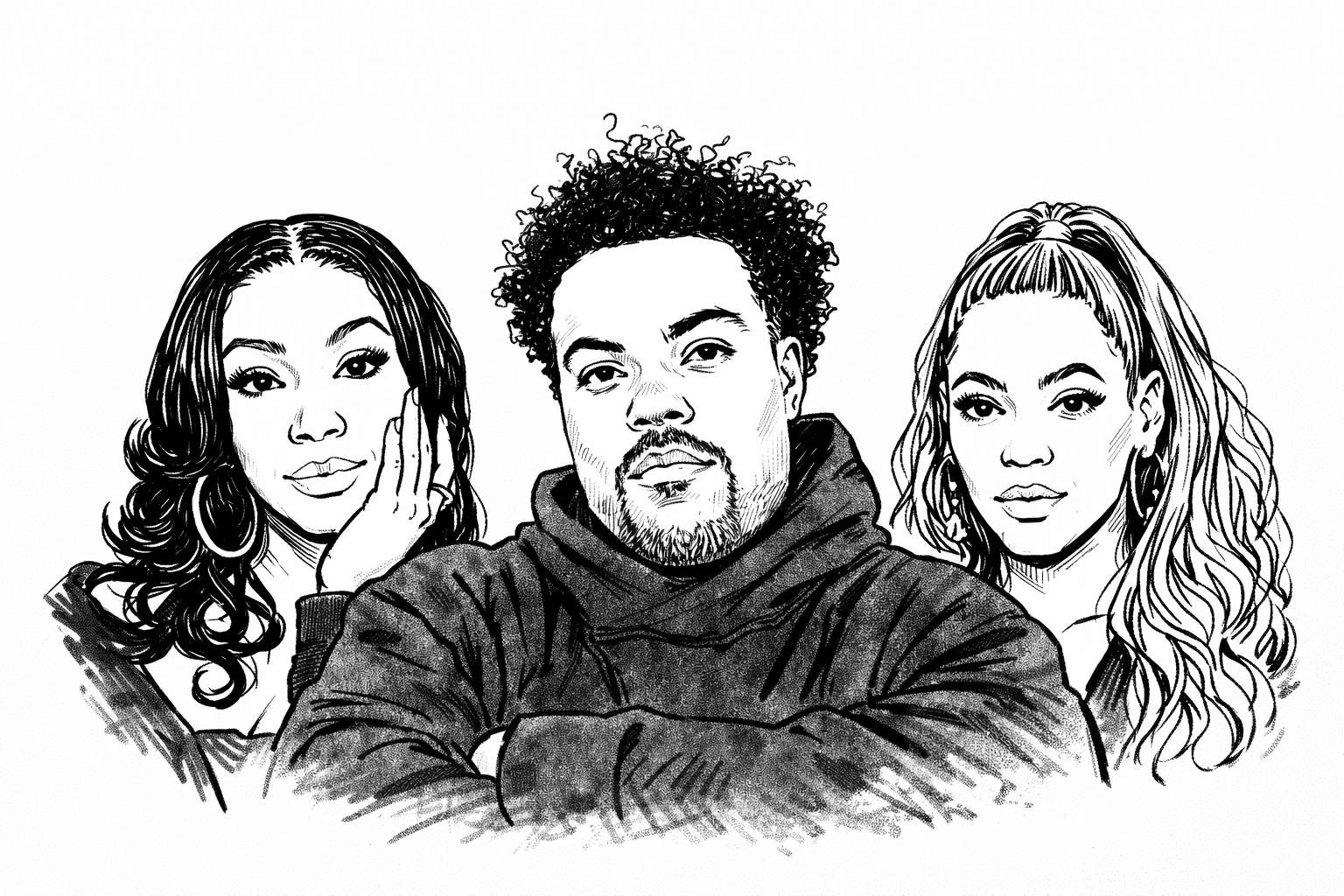
Part of The Critic’s Desk — examining music, authorship, and the stories behind the sound.
Brandy received her star on the Hollywood Walk of Fame on March 30, 2026. Four days later, her memoir Phases dropped — and a passage from it has been circulating ever since, not because it’s the most dramatic thing in the book, but because it’s the most honest.
She describes the moment her working relationship with Rodney Jerkins — Darkchild — effectively ended. The specifics, as she recounts them, are sharp. In the middle of a creative disagreement, he tells her to go do what she’s going to do while he goes and sells 5 million records with Beyoncé. The line lands not just as conflict, but as finality. Not a disagreement about a song. A reallocation of attention, resources, and cultural momentum — stated plainly, in the room, to her face.
For a certain era of R&B, Brandy and Darkchild were not just collaborators. They were architects of a sound. The Boy Is Mine — which Brandy has said she conceived while watching Jerry Springer, pitching the idea of two artists going back and forth before Jerkins and LaShawn Daniels helped shape it into what it became — went to number one, won a Grammy, and brought her and Monica back on tour together 27 years later in 2025. Never Say Never. Full Moon. The vocal precision, the layering, the specific texture of late ‘90s and early 2000s R&B that felt like it belonged to both of them. It was influential in ways that outlasted both the commercial moment and the partnership itself.
What Phases breaks is the illusion that the partnership was ever symmetrical. It wasn’t just creative — it was relational, almost familial, the kind where both sides know exactly how to push each other. That closeness can produce brilliance. It can also produce rupture. And when it ruptures, the person with more market options is rarely the one who absorbs the cost.
That is the layer the Beyoncé line exposes. It is not simply competitive energy. It is a statement about leverage. Jerkins was not wrong that he had options — he did. But the way he named those options, in that moment, to that person, reveals something about how the industry positions Black women against each other as a management tool. As SSC covered in What Happened to R&B Music , the triangulation of Black women in creative industries — using one woman’s visibility or commercial momentum as a pressure point against another — is a tactic with a long history. It does not require malice to function. It requires only a power imbalance and a willingness to name it.
There is a broader structural truth underneath Brandy’s reflection. Sound is rarely owned by a single person, even when it becomes associated with one. Producers, writers, and artists exist in a constant negotiation of credit, direction, and creative evolution. When a producer shifts their focus, they don’t just change collaborators — they often reshape the sonic landscape around them. What once felt like a shared language can quickly become something someone else is now speaking more fluently, or more commercially. The artist left behind does not lose only the collaboration. She loses the infrastructure that made the sound possible — the production relationship, the publishing connections, the industry credibility that came from being the person that hitmaker was building with.
What makes the moment resonate now is its timing. Brandy is getting a star on the Walk of Fame, a formal acknowledgment of a career that the industry treated unevenly in real time. The memoir is arriving at the moment of institutional recognition, which means it is also arriving as a correction — a first-person account of what the official narrative left out. The Darkchild moment is one of those corrections. Not because Jerkins is a villain in it, but because the structure he operated within is exactly as asymmetrical as Brandy describes, and it always has been.
As SSC covered in Ari Lennox, Jill Scott, and the Cardi B Rollout Model and the Spotify royalties piece, the infrastructure of Black women’s music careers has consistently been organized around their talent while controlled by someone else’s leverage. The hitmaker moves on. The catalog stays. The sound persists. And the question of who owns it — who captured the value of the collaboration while it was happening and who absorbed the cost when it ended — is the question the Walk of Fame ceremony does not answer.
Why This Matters
When a defining creative partnership ends, it doesn’t just close a chapter. It redistributes influence — and it rarely redistributes it evenly. The question is not whether Brandy belongs on the Walk of Fame. She does. The question is what it means that the memoir had to exist at all — that the full account of what building that career actually cost her required a book, not an industry that was honest about it in real time.