
Part of Culture in Motion — examining who defines culture, how it moves, and what it reveals about the moment.
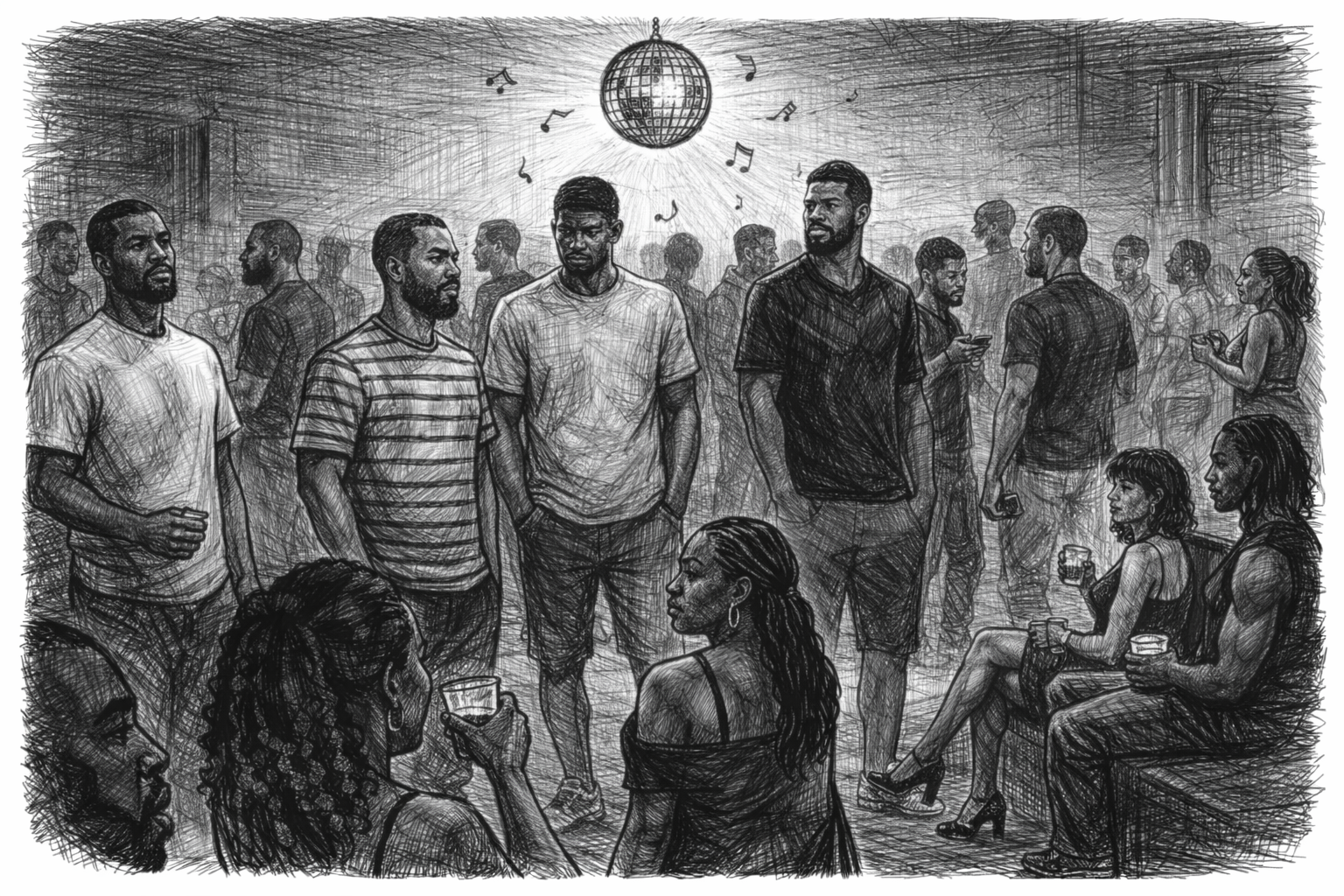
I watched the footage from the 6ft+ party in London and laughed. I think most people did. The room was full of tall men and completely empty of energy — a curated crowd with nowhere to go, standing around in a space that had been designed around a single trait and had produced nothing from it. The comments were immediate and accurate. No dancing. No chemistry. No there there.
But I kept thinking about something underneath the joke. Because I know that preference logic. I’ve been on the receiving end of a version of it my whole life.
As a Black woman, I have watched men sort through women by complexion. By whether someone was light enough, dark enough, closer to one beauty standard or further from another. I have heard the language of preference used to justify what is functionally a hierarchy — one that did not originate with the men using it and did not benefit the women being sorted through it. The preference always got presented as personal, neutral, just what someone was into. But preferences don’t exist in a vacuum. They come from somewhere. They carry something. And you cannot build a room — literal or social — around a single filter and then act surprised when the room doesn’t feel like a place where human beings connect.
That is what the 6ft+ party actually demonstrated. Not that height is an unimportant factor in attraction. But that a single attribute, extracted from context and elevated to a filtering system, produces exactly the environment you’d expect: people who meet the criteria, standing in a room that cannot answer the question of what happens next.
The premise misunderstands what actually creates chemistry. Height, like any single physical trait, does not produce personality, humor, confidence, curiosity, or presence. It is a proxy that works online because it simplifies decision-making — and simplification is the native logic of the filter. But in real life, where interaction is continuous and unscripted, simplification breaks down. You can filter for who gets into the room. You cannot filter for what happens once they’re inside.
There is also a layer the event footage doesn’t surface and that most of the commentary skipped past. The preference for height in dating culture is not neutral. It is racialized in ways that rarely get named directly. The men most culturally associated with the height preference in mainstream dating discourse — the ones whose presence in that room was implicitly imagined when the concept was built — are not evenly distributed across race. Certain bodies get coded as the aspirational version of the filter and others get coded as incidental to it. The “6ft+ party” operates as if height is just a measurement. In practice, it activates a set of cultural associations that are about more than inches.
This is the distinction between preference as internal cultural knowledge and preference as a sorting system. When Black men joke about height culture in dating — about the 5’11” who writes 6’0” on his profile, about the specific calculus of Timberlands — that is a conversation that knows what it carries. It understands the context, the racial dimension, the particular way these filters get applied. When that preference gets extracted and turned into an event concept, it stops being a joke about culture and becomes a filter that doesn’t have to acknowledge what it’s sorting for.
The same thing happens with the complexion preferences I’ve watched operate my entire life — and the racial preferences that Black women navigate in dating spaces where being Black is itself treated as a filter point. You cannot solely rely on your preference. Not because preferences don’t exist or don’t matter, but because a preference that cannot account for what it carries — where it came from, who it centers, who it edges out — is not a preference. It is a sorting system with a personal branding problem. And sorting systems, when you build a room around them, tend to produce exactly what the 6ft+ party produced: a crowd that met the criteria and a space that had nothing to offer them once they were inside.
As I covered in Dating Apps Didn’t Break Dating — They Exposed It and He Was Everything on Paper, the infrastructure of modern attraction has become increasingly filter-driven — height, income, aesthetics, follower counts. The more social life gets reduced to single-attribute sorting, the more it begins to resemble a logistics operation rather than an experience. The comment asking for “people with personalities and hobbies” reads like a throwaway line, but it carries real weight. It points to the gap between what people say they want and what the filtering systems being built to deliver it can actually produce.
The 6ft+ party didn’t fail because of who showed up. It failed because of what the premise prioritized — and because it presented a culturally specific, historically loaded preference as a universal and neutral one, without the self-awareness that the original context required. It treated a single attribute as if it could hold an entire social experience. And in doing so, it exposed something the internet consistently obscures. Desirability is not a room. It’s a dynamic. You cannot sort your way to connection. And when you try, the room you build will always feel like no one is really there — because the part of a person that makes connection possible was never on the checklist.
Why This Matters
As more of social life gets shaped by algorithmic logic, we are seeing more real-world attempts to replicate what performs online. Not all of it translates — and when it doesn’t, it reveals the difference between attention and connection. But it also reveals something else: preferences that circulate as neutral and personal are rarely either. The filter has a history. The sorting system has a cost. And the people who absorb that cost — the Black women navigating complexion hierarchies, the communities whose bodies get coded as peripheral to someone else’s criteria — have always understood something the 6ft+ party had to learn the hard way. You cannot build a room around what you think you want and be surprised when it doesn’t feel like a place where anyone belongs.