
Part of Society, Economy & Wellness — examining how economic pressure reshapes labor, access, and everyday life.
Beneath the tariff headlines, gas price shocks, and recession projections, a slower and more consequential shift is underway. The architecture of global trade — the system of dollar-denominated transactions, multilateral institutions, and American economic leadership that has structured the world economy since World War II — is being openly questioned by a growing coalition of countries. That questioning is no longer theoretical.
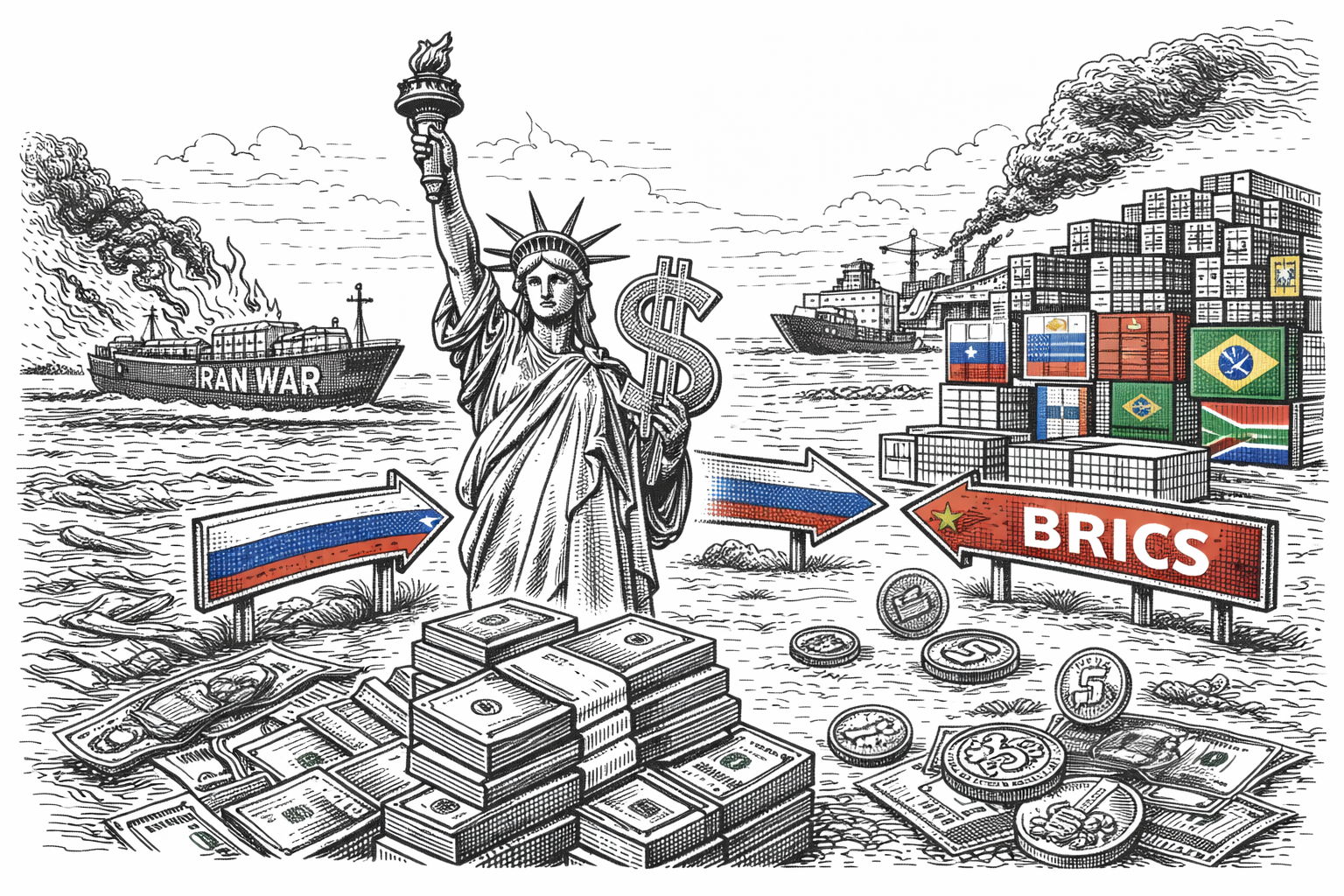
The BRICS nations — Brazil, Russia, India, China, South Africa, and newer members — are building payment infrastructure designed to route transactions outside the US dollar system. The mBridge platform, developed by China in collaboration with the Bank for International Settlements, enables cross-border transactions in local currencies without dollar conversion. Saudi Arabia has begun accepting yuan for some oil transactions. The petrochemical trade, long anchored in the dollar, is now being renegotiated at the margins. None of this has tipped the system. All of it is accelerating.
The Iran war and Trump’s tariff regime are reinforcing that shift. Sanctions and trade pressure often push targeted countries and their partners toward alternative systems faster than they would otherwise move. Iran, largely cut off from dollar-based systems, has functioned as a testing ground for yuan-denominated trade. Russia, under sanctions since 2022, has expanded ruble and yuan settlement at scale. Countries observing these shifts — including Nigeria, Ghana, and other West African economies — are drawing their own conclusions about the cost of dollar dependence, particularly when exports are priced in dollars but domestic economies operate in currencies that have weakened against it.
Research from the Joint Center for Political and Economic Studies found that Trump’s tariff policies have placed disproportionate strain on communities already navigating economic barriers, with Black Americans and Black-owned businesses absorbing a significant share of the impact. That domestic reality and the global de-dollarization conversation are more connected than they are often framed. The dollar’s reserve status allows the United States to sustain trade and fiscal deficits that underpin its domestic economy. If that status is challenged, the adjustment costs will not be distributed evenly. They will follow familiar fault lines — concentrating on communities with the least institutional protection and the least capacity to absorb disruption.
For West African economies, a shift away from dollar dependence in commodity pricing presents both risk and opportunity. Pricing oil, gold, cocoa, and other exports in currencies tied more closely to actual trading relationships could reduce structural disadvantages embedded in the current system. Ghana’s gold sector reforms, Nigeria’s Dangote refinery, and the African Continental Free Trade Area’s push toward intra-African trade in local currencies all point toward a potential alternative architecture. Whether that system materializes — and who benefits from it if it does — is the upstream version of the access questions SSC has been tracing across sectors.
As SSC documented in The Black Recession Is Already Here and When the Economy Slows, Black communities in the United States have historically absorbed the earliest and most sustained impacts of economic instability. The de-dollarization conversation is not separate from that pattern. It is part of the broader structural context that helps explain why those disparities persist — and why they are so difficult to correct with existing policy tools.
Why This Matters
The global economic architecture is not neutral, and it is not fixed. The dollar-based system that has structured world trade for decades is being contested at the same moment its domestic inequalities are becoming more visible. Those developments are connected. The communities that have borne the greatest cost under the current system have the most at stake in what comes next. SSC will continue to track this shift, because the question of who the next economic architecture is built for is the same question underlying every system we examine.