
Part of Culture in Motion — examining who defines culture, how it moves, and what it reveals about the moment.
I am training for HYROX. I want to put that on the table at the start, because this piece is partly about what that decision revealed to me — not just about the event itself, but about the system I walked into when I signed up for it.
I train at Life Time and Gold’s Gym in Houston. I also have a membership at EōS Fitness. I wear an Ultrahuman ring. At Life Time, the Alpha group fitness classes I take are built on HYROX modules — functional movements, timed intervals, the same framework the race itself uses. I didn’t have to register for a HYROX event to start training like I was preparing for one. The event came to me, embedded in the class format of one of the country’s largest premium fitness chains. That’s when I started paying attention to what was actually happening.
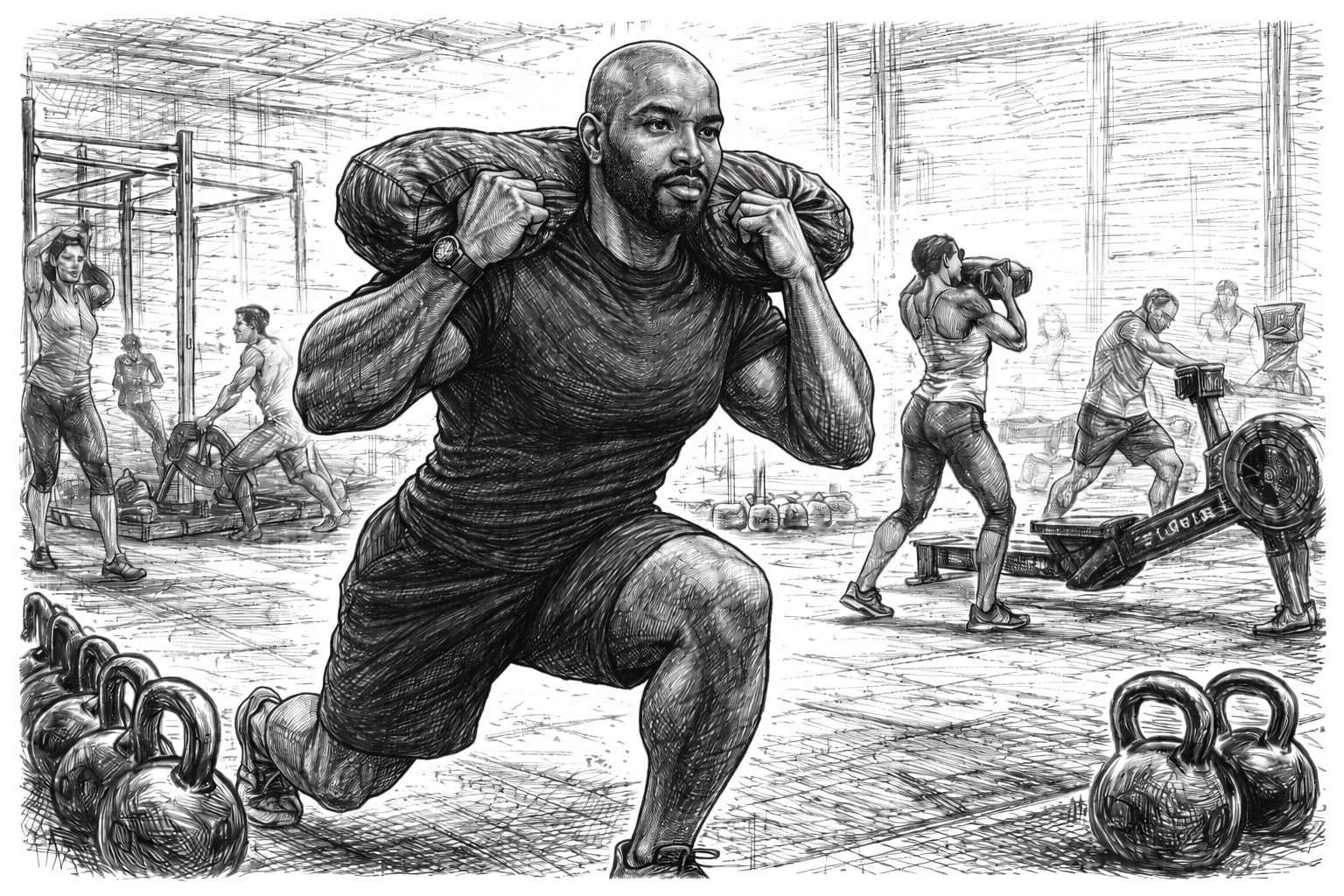
HYROX bills itself as “the world series of fitness racing,” but what it actually represents is something more precise. It takes a familiar set of functional movements — running, sled pushes, lunges, ski ergs, wall balls, carries — and arranges them into a standardized format that can be replicated in any city, at any time, with anyone competing under the same conditions. The appeal is immediate. It makes fitness legible. You don’t just work out. You train for something measurable, comparable, and public.
That distinction is why it’s spreading the way it is. Traditional gym culture has always been fragmented. Workouts vary. Goals are personal. Progress is often internal. HYROX removes that ambiguity. It gives people a scoreboard. And once a scoreboard exists, behavior changes. Training becomes more intentional. Identity becomes more defined. You’re no longer just “in shape.” You’re preparing — for something that has a date, a registration fee, and a results page that will exist long after race day.
What’s emerging is not just a fitness trend. It’s a system. Gyms are structuring programming around HYROX-style training — not as a niche add-on but as a core class format. Life Time’s Alpha program is one example: a group fitness framework built directly on HYROX movement modules, available to members who may never intend to race but are training inside the system regardless. And at a recently opened Club Studio location in Houston, HYROX has gone further still. The facility spans 20,000 square feet — and within that footprint, a dedicated HYROX training space has been carved out and purpose-built for the format. That is not programming philosophy. That is architecture. When a premium fitness brand allocates square footage specifically to a race format inside a new build, the event has stopped being a trend and started being infrastructure.
Coaches are branding themselves around race prep. Influencers are documenting their times, their improvements, their placements. The workout becomes content. The content becomes marketing. And the marketing feeds the next wave of participants entering the same pipeline. The gym is no longer just a place where you go to get in shape — it is a market where different tiers of access, equipment, community, and aspiration are priced accordingly. HYROX sits at the premium end of that market, and it knows it.
That system sits at the intersection of two larger shifts in how people relate to their bodies and their time. The first is the rise of hybrid fitness, where endurance and strength are no longer separate training philosophies but a single integrated pursuit. The second is the growing demand for experiences over routines — people don’t just want to work out, they want to test themselves in a setting that feels official, communal, and visible. HYROX delivers all three. It also charges a registration fee that reflects exactly how much the market has decided that experience is worth.
I think about that when I’m in an Alpha class at 6 a.m. running through a HYROX module I’m doing voluntarily, that is genuinely making me stronger and more consistent. But I’m also aware that the discipline I feel like I’m building for myself has been partially organized by a brand that profits from my participation — from the registration, the merchandise, the content I consume to prepare, and the gym programming I pay for that is designed around the event. That is not a criticism. It is an observation about how thoroughly fitness has been industrialized, and how naturally I stepped into that industrialization without fully registering it.
The other thing I notice is who I see in HYROX spaces and who I don’t. The event skews toward a specific demographic — one with the disposable income for race registration, the flexibility for structured training, and the cultural relationship to fitness as performance and identity rather than necessity. As SSC documented in the EōS Fitness piece and The New Fitness Economy Is Tiered, the gym landscape in Houston tells that story clearly — Life Time at the premium end, Gold’s in the middle, EōS at the value tier — each serving a different version of the same city’s fitness aspirations, segmented by price and amenity. HYROX adds another layer to that segmentation — not by exclusion but by design. The communities that use fitness as a practical tool for health and longevity are not the primary audience for a branded race format built around content and community visibility. That gap is worth naming even when you are, as I am, inside the system that created it.
HYROX didn’t create these dynamics. It organized them. It took existing behaviors — competition, tracking, identity, community — and gave them a format that scales globally. That’s why it feels less like a trend and more like infrastructure. Something designed not just to grow, but to repeat. And I’ll be at the starting line, split time ready, fully aware of what I’ve opted into.
Why This Matters
Fitness is moving from private routine to public system. HYROX is one of the clearest examples of that shift — where working out becomes something you enter, measure, and compare across a global field. The question isn’t whether people will keep training. Most will. The question is what the industrialization of that training produces over time — and whether the communities with the most to gain from fitness infrastructure are the ones the system is actually being designed to reach. I don’t have a clean answer. I have a race to train for. But I think both things can be true at the same time.