
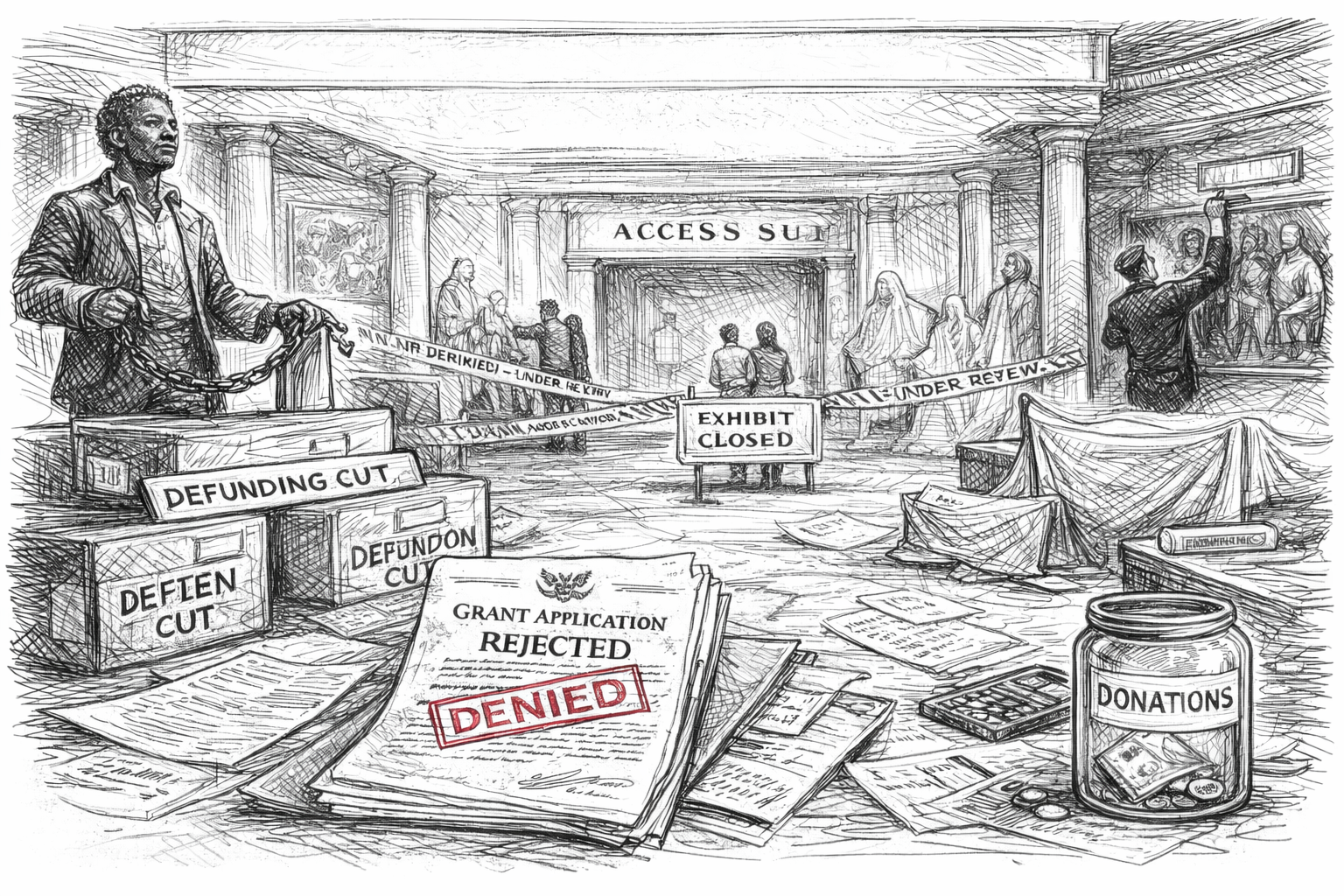
Part of The Access Shift — an ongoing series examining how access is being quietly reshaped across American life.
Across the United States, museums are entering a new kind of constraint. It is not defined by attendance or relevance. It is defined by what they can afford to say — and what they can no longer afford to exhibit.
The mechanism is not subtle once you see it clearly. Executive Order 14253, titled Restoring Truth and Sanity to American History, directed museums to remove “divisive narratives” and “improper ideology” from their programming — and singled out the National Museum of African American History and Culture, the American Art Museum, and the Women’s History Museum by name. Museums were given 120 days to replace “divisive or ideologically driven language with unifying, historically accurate and constructive descriptions.” The enforcement arm is funding. The Institute of Museum and Library Services — the federal agency that distributes grants to museums and libraries nationwide — was gutted, with its entire staff placed on administrative leave. Hundreds of previously awarded grants were terminated.
The language the administration used to justify those terminations tells the story precisely. In a letter to grantees, the IMLS acting director wrote that their grants were “no longer consistent with the agency’s priorities and no longer serves the interest of the United States.” The Whitney Plantation in Louisiana — the only plantation museum in the country dedicated solely to honoring the lives of enslaved people — lost two federal grants totaling nearly $350,000, including funding for an exhibition on enslaved people’s resistance that was three years in the making and scheduled to open in 2026. The grant had already been approved for final disbursement. The federal agency was gutted the following day.
The impact on Black cultural institutions is direct and escalating. At the Charles H. Wright Museum of African American History in Detroit — one of the largest and oldest African American museums in the world — the museum’s president reported that federal funding once specifically dedicated to Black museums has been eliminated, and that federal grants must now be rewritten so as not to specifically target a racial group. The new federal rules are “making it challenging, if not impossible, for African American museums, and indeed all museums of color to apply.” In Boston, the Museum of African American History lost a $500,000 federal grant — representing 16.6% of its annual budget — and was told its work was no longer consistent with the administration’s priorities. The museum subsequently declined further National Park Service funding due to concerns about federal interference in its programming.
These are not isolated cases. When the administration moved to cancel grants and lay off staff at the IMLS, NEA, and NEH — contradicting congressional allocations — hundreds of institutions found themselves with sudden financial gaps. Those affected have had to cut programs, reduce hours, and let go of staff. The chilling effect extends further than the direct cuts. The federal government’s example has led once-reliable private sponsors like corporations to decline supporting programs under scrutiny. The administration has also threatened to revoke the nonprofit status of organizations it disagrees with — including private foundations that fund museums’ contributed income. Institutions that can find funding for exhibitions that widen the American story now face the additional calculation of whether the visibility is worth the risk.
This is the shift. Cultural institutions have historically functioned as sites of interpretation, preservation, and critique. That role depends on independence — the ability to present history as it was experienced, not as it is politically convenient. When that independence becomes contingent on funding, the institution itself changes. It becomes less of a public space and more of a managed one. As SSC covered in The Federal Government Just Redefined DEI as Discrimination and the HMAAC Houston piece, the pressure on Black cultural institutions is not coming through a single policy channel. It is arriving simultaneously through grant terminations, executive orders, agency gutting, and the withdrawal of private support from corporations unwilling to be associated with anything the federal government has labeled divisive. The cumulative effect is a field being reshaped — not through a single dramatic act, but through the slow withdrawal of the conditions that made independence possible.
What is preserved narrows. What is presented shifts. What is omitted becomes harder to detect over time.
Why This Matters
This is not a story about budgets. It is a story about who controls the record. When the federal government can terminate a grant for an exhibition about enslaved people’s resistance and describe that termination as no longer serving the interest of the United States, the question of what counts as American history has been answered — and answered by the same institutions whose history these museums were built to correct. Cultural institutions that serve Black communities are being asked to choose between financial survival and narrative integrity. Many will find ways to resist. Some will not be able to afford to. And the history that doesn’t get told in those rooms will not announce its own absence.