
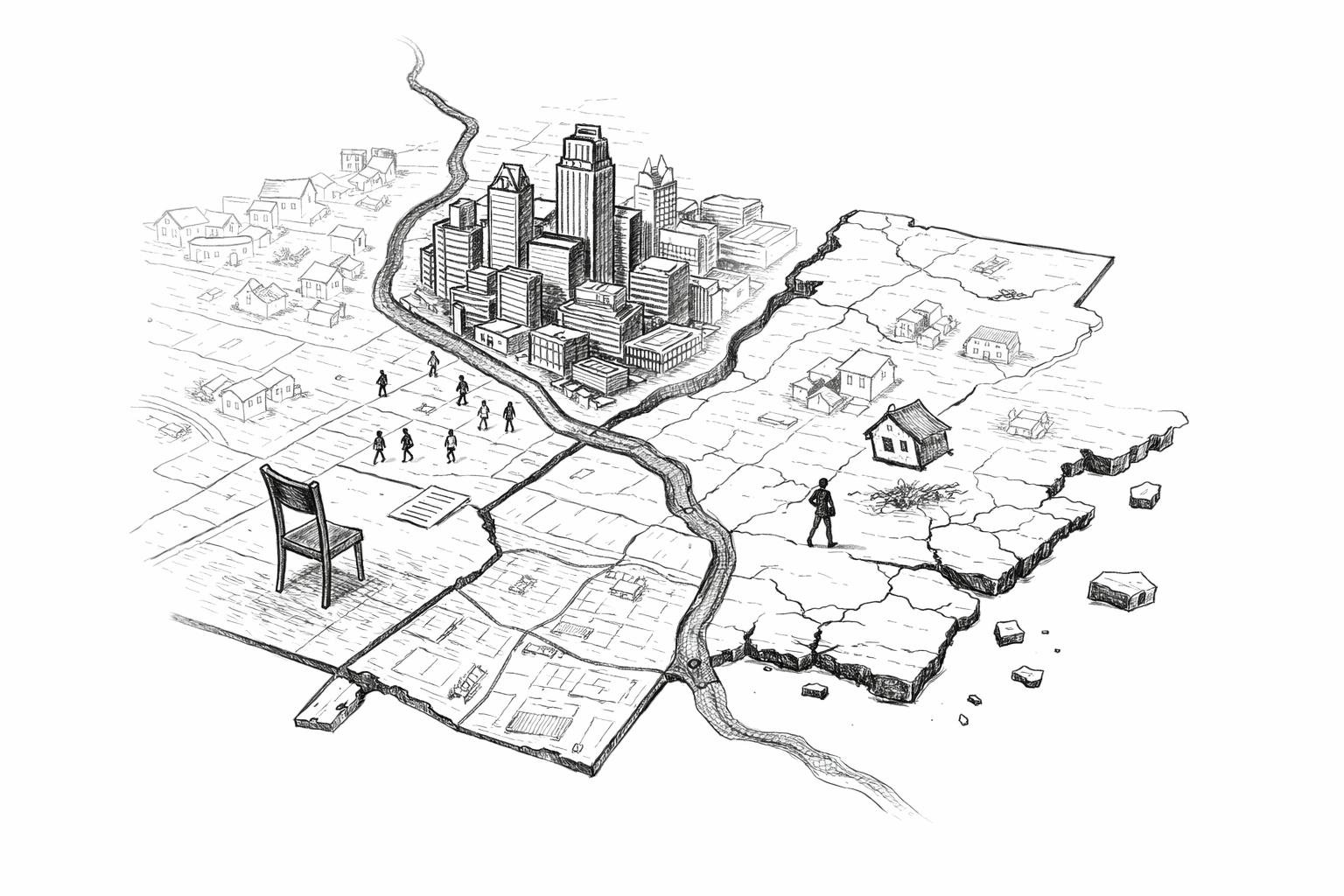

Austin now ranks among the top U.S. cities for millennial inflow, according to SmartAsset’s 2026 “Where Millennials Are Moving” study — driven by remote work flexibility, job growth, and lifestyle appeal. The framing is familiar. A growing tech hub. A cultural hotspot. A place where opportunity and lifestyle converge.
But those rankings only measure who is arriving. They do not account for who is being displaced to make room.
Research from the Urban Displacement Project identifies Austin’s Eastern Crescent — historically Black and Latino — as among the most at-risk neighborhoods for displacement, many of which have already undergone significant demographic change. That pattern traces back to the city’s 1928 master plan, which confined Black residents to East Austin and set the conditions for decades of disinvestment and redlining. When those same neighborhoods became desirable, rising property values did not benefit the communities that endured that isolation. They priced them out.
The current wave of millennial migration accelerates that pattern. And policy shifts framed as modernization are compounding the pressure. Austin’s planned transition to fully cashless public transit — set for June 1 — introduces new barriers for unbanked riders, who are disproportionately people of color. That dynamic is not incidental. It reflects a broader pattern we’ve been tracking: systems being redesigned in ways that appear more efficient on the surface, but quietly narrow access in practice. A recent report card on Austin’s growth and equity outcomes underscores that tension — highlighting a city continuing to prioritize expansion and innovation while falling short on inclusion. The move toward cashless transit fits squarely within that pattern: a policy framed as modernization that, in effect, determines who can move freely within the city.
The result is a city being experienced at two levels simultaneously. One defined by growth and national attention. The other defined by displacement and loss of place.
Why It Matters When migration is measured without accounting for displacement, the story becomes incomplete. Cities are not just shaped by who arrives, but by who is able to remain. Without that distinction, growth can be celebrated while its consequences remain unexamined.