
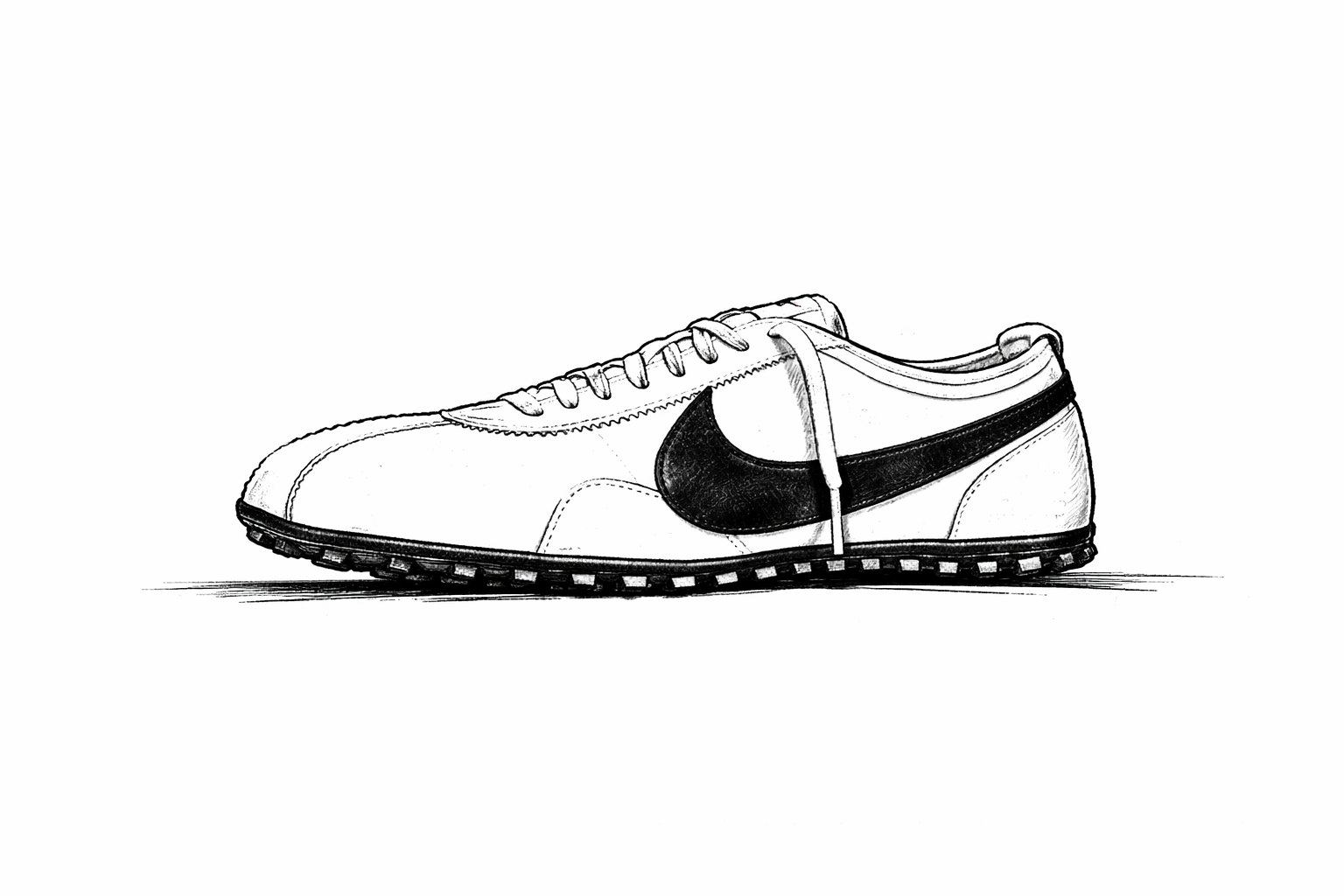
Nike is reaching back into its archive and pulling forward one of the most foundational designs in sneaker history. According to GQ, the brand is officially bringing back the Nike Moon Shoe, a silhouette that traces directly to the company’s earliest experiments with performance footwear and its now-iconic waffle sole.
The reissue follows a soft reintroduction through Nike’s collaboration with Jacquemus, which quietly positioned the Moon Shoe within a broader shift toward slimmer, more minimal sneaker profiles. That drop resonated not because it was loud, but because it wasn’t. The design felt intentional, understated, and aligned with a growing preference for “torpedo” silhouettes over bulkier, more exaggerated footwear. Now, Nike is building on that momentum with a wider in-house release.
The updated version stays close to its roots. A leather and nylon upper replaces the crinkled texture of earlier iterations, while the colorway remains restrained: white base, black Swoosh, black waffle sole. It is a deliberate return to simplicity. The design does not compete for attention. It complements it. That restraint is part of the appeal, especially in a market that has spent years cycling through maximalism.
The story behind the shoe remains central to its significance. As GQ recounts, the original concept dates back to the 1950s, when track coach Bill Bowerman experimented with a waffle iron to create traction patterns for running shoes. Only a handful of early pairs were made, including those worn during the 1972 Olympic Trials. Decades later, those prototypes have become collector artifacts, with one pair selling for nearly $500,000 at auction.
Nike’s decision to bring the Moon Shoe back now is not just about nostalgia. It is about timing. The sneaker market is shifting away from hype-driven scarcity toward products that feel more wearable, more versatile, and more grounded in design history. At $105, the reissue is also positioned at a more accessible price point than many recent drops, widening the audience without diluting the brand’s legacy.
That shift is notable in the context of Nike’s broader positioning. As explored in Nike Put Its Mark on a Black Body. The Internet Noticed., the brand does not always control how its products and campaigns are interpreted once they enter the public. Meaning can shift quickly, often in ways that reflect cultural memory more than brand intent. The Moon Shoe release moves in the opposite direction—away from provocation and toward control—grounding the product in origin, design, and credibility rather than ambiguity.
Why it matters
This release signals a recalibration in how Nike is thinking about value. For years, scarcity and spectacle drove demand. The Moon Shoe represents something different: credibility rooted in origin. By reintroducing one of its earliest designs in a simplified, accessible form, Nike is not just selling a sneaker. It is reinforcing the idea that legacy, when timed correctly, can function as strategy—and that control over meaning is easiest to maintain when the story starts at the source.
.