
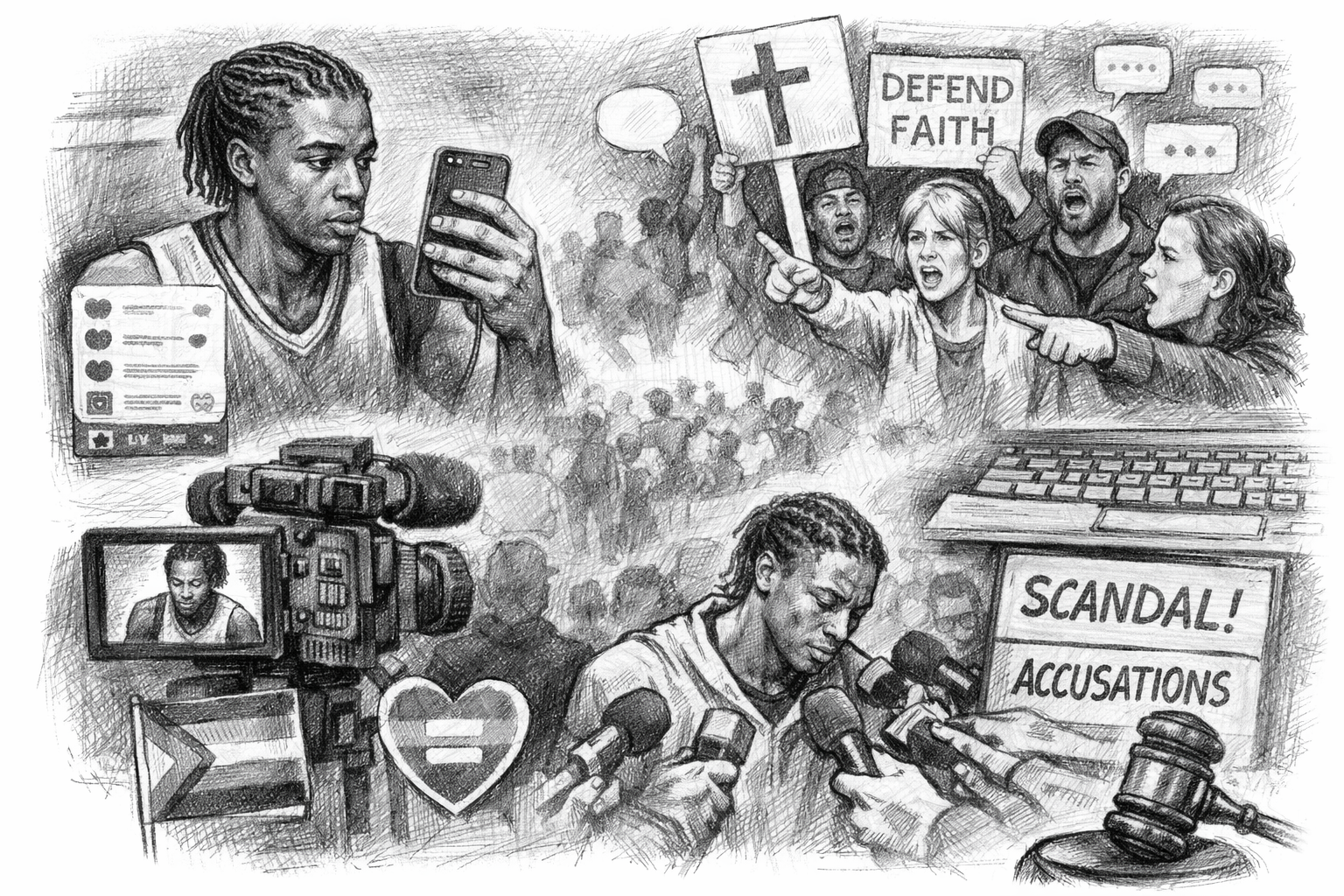
The situation surrounding Jaden Ivey did not begin as a vague controversy. It began with specific, public statements. In a series of livestream remarks, Ivey framed LGBTQ+ identity as immoral through a religious lens and criticised the NBA’s support of Pride initiatives. Those comments were not private. They were broadcast, circulated, and attached to a league that has made inclusion a central and documented part of its public identity — a league that relocated its 2017 All-Star Game from Charlotte to New Orleans specifically in protest of North Carolina’s anti-LGBTQ+ legislation, and that has partnered with You Can Play to affirm the place of LGBTQ+ athletes at every level of the sport.
That is the starting point. And it is enough on its own.
When belief is expressed in a way that targets a group of people, it moves beyond personal conviction. It becomes a public act with consequences. Language that frames LGBTQ+ people as sinful or unrighteous does not exist in isolation — it contributes to an environment where exclusion is justified and reinforced. The Trevor Project’s research consistently shows that LGBTQ+ young people who encounter negative messaging from public figures report measurably higher rates of distress. Words from high-profile athletes reach far. Homophobia causes harm, and it should be rejected.
In other clips, Ivey frames his own life through that same moral lens, describing past behaviour — sex, pornography, and alcohol — as part of a personal history he has since rejected through faith. That context matters. It shows that his comments are not random, but rooted in a specific framework centred on sin and transformation. Understanding that framework helps clarify where he is coming from. But applying it outward — to the identities of others — is where the issue shifts. Personal conviction becomes public judgment, and the line between belief and harm begins to blur.
From there, the response followed a familiar pattern. The organization acted. The public reacted. And then the narrative expanded. What started as a clear issue — harmful public rhetoric — quickly became something more diffuse. Other athletes stepped in to defend the comments through religious framing, positioning criticism as persecution rather than accountability. Online discourse introduced new angles, new claims, and new comparisons, many of them disconnected from the original moment but effective at pulling attention away from it. That drift is not accidental. It is how uncomfortable accountability gets absorbed into noise.
In the midst of that expansion, resurfaced clips emerged in which Ivey describes having anger that led him to being “somewhat of an abuser.” That statement is serious. But seriousness requires precision. A partial admission, presented without full context, is not the same as a complete account. Turning that language into a definitive headline may generate engagement, but it risks flattening a complex and consequential issue into something consumable rather than understood — and in doing so, it does a disservice to anyone whose experience of harm deserves more than a news cycle.
This is where the deeper shift happens. The focus moves from what was said to who he is. From a specific act to a broader judgment of character. And once that shift takes hold, the conversation becomes difficult to steer. Personal relationships become content. Allegations — verified or not — enter the narrative. Other public figures are pulled in as points of comparison. The original harm remains, but it is no longer the centre of the discussion.
We can be clear without being careless. Homophobia should be rejected. That does not require neutrality or hesitation. But clarity also requires discipline. Not every claim that emerges in the aftermath carries the same weight. Not every viral post deserves to reshape the narrative. And when everything is treated as equally definitive, the conversation loses its ability to distinguish between what is known, what is alleged, and what is simply being amplified.
Why It Matters
When the focus keeps shifting, accountability becomes unstable. What begins as a clear moment of harm can be diluted, redirected, or replaced entirely by a louder and messier story. And when that happens, the systems that are supposed to respond to harm are no longer reacting to reality — they are reacting to noise. The original harm, and the people it affected, get lost in the process. Keeping the focus on what was actually said, and what it actually means, is not a limitation. It is the only way accountability holds.