
NATIONAL | HOSPITALITY | ANALYSIS
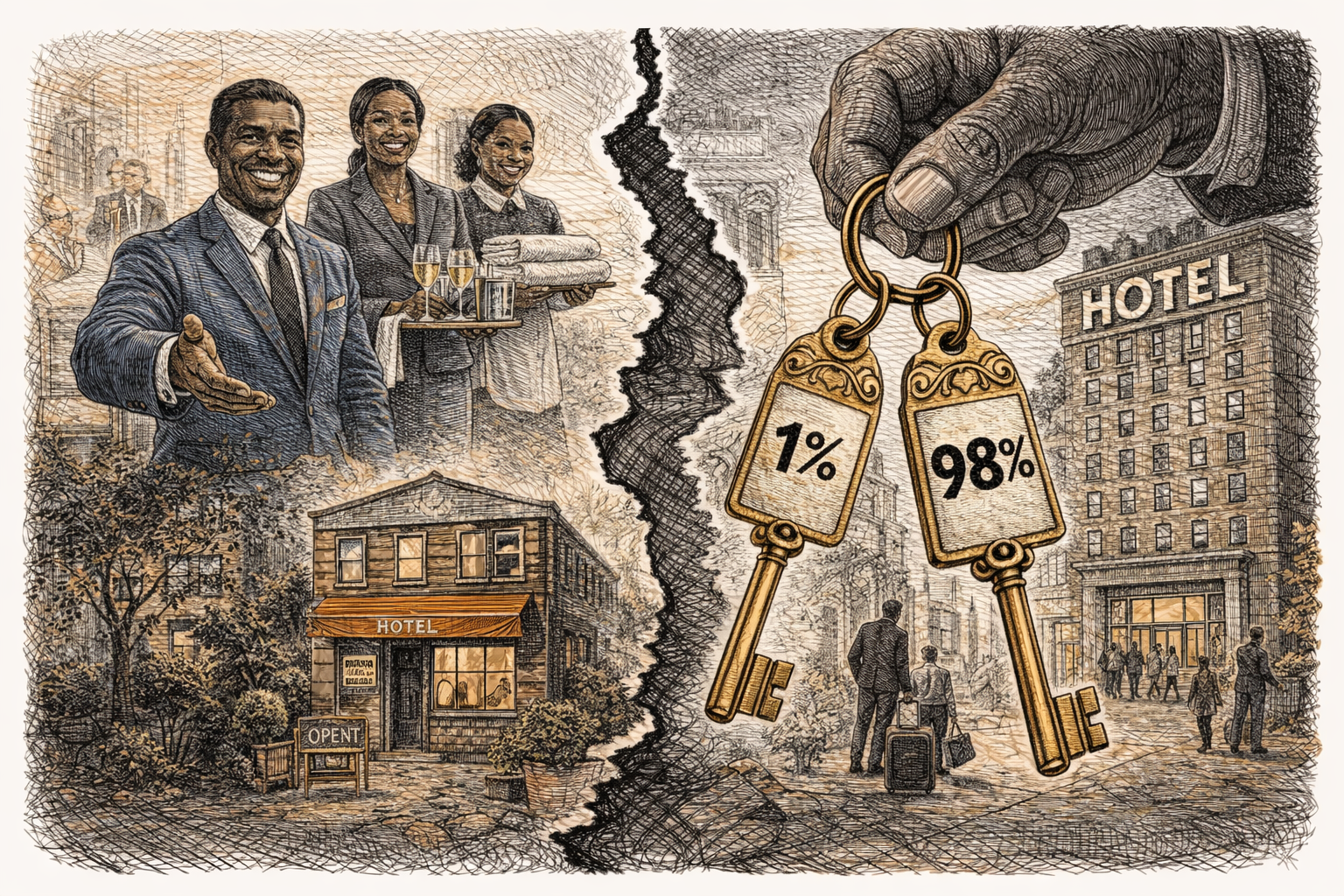
Black professionals hold 1.6% of executive roles across the hospitality industry. Fewer than 2% of the roughly 60,000 hotels in the United States are Black-owned. Less than 1% are owned by Black women.
Those numbers sit inside an industry that runs on experience, service, and cultural fluency — areas where Black Americans have long shaped expectations, from music and ambiance to customer engagement and brand identity. Those contributions are embedded in how hospitality operates. They are not reflected in who owns or leads it.
Companies like IHG Hotels & Resorts and Hilton Worldwide have introduced capital commitments and diversity targets aimed at expanding ownership pipelines. But those efforts exist within a system where the real gatekeeping happens earlier — through financing, franchising approvals, and development networks that determine who can actually own at scale. The commitments address the surface. The structure underneath remains intact.
The pattern is not unique to hospitality. As Black Media Isn’t Just Growing — It’s Building Its Own Infrastructure examined, the distinction between participation and ownership is where the real power question lives. And as After the Boycott, the Harder Question explored, the move from consumer pressure to actual ownership is where most economic activism stalls. Hospitality is one of the clearest examples of why that stall matters — because the industry expands participation precisely because participation doesn’t disrupt control.
More operators. More visibility. More inclusion at the surface. Ownership concentrated in the same hands.
In hospitality, that means Black presence can shape the experience without reshaping the balance sheet. The culture travels. The ownership doesn’t.
The industry frames incremental gains as progress. The numbers suggest something more fixed. Participation is widening. Control is holding.