
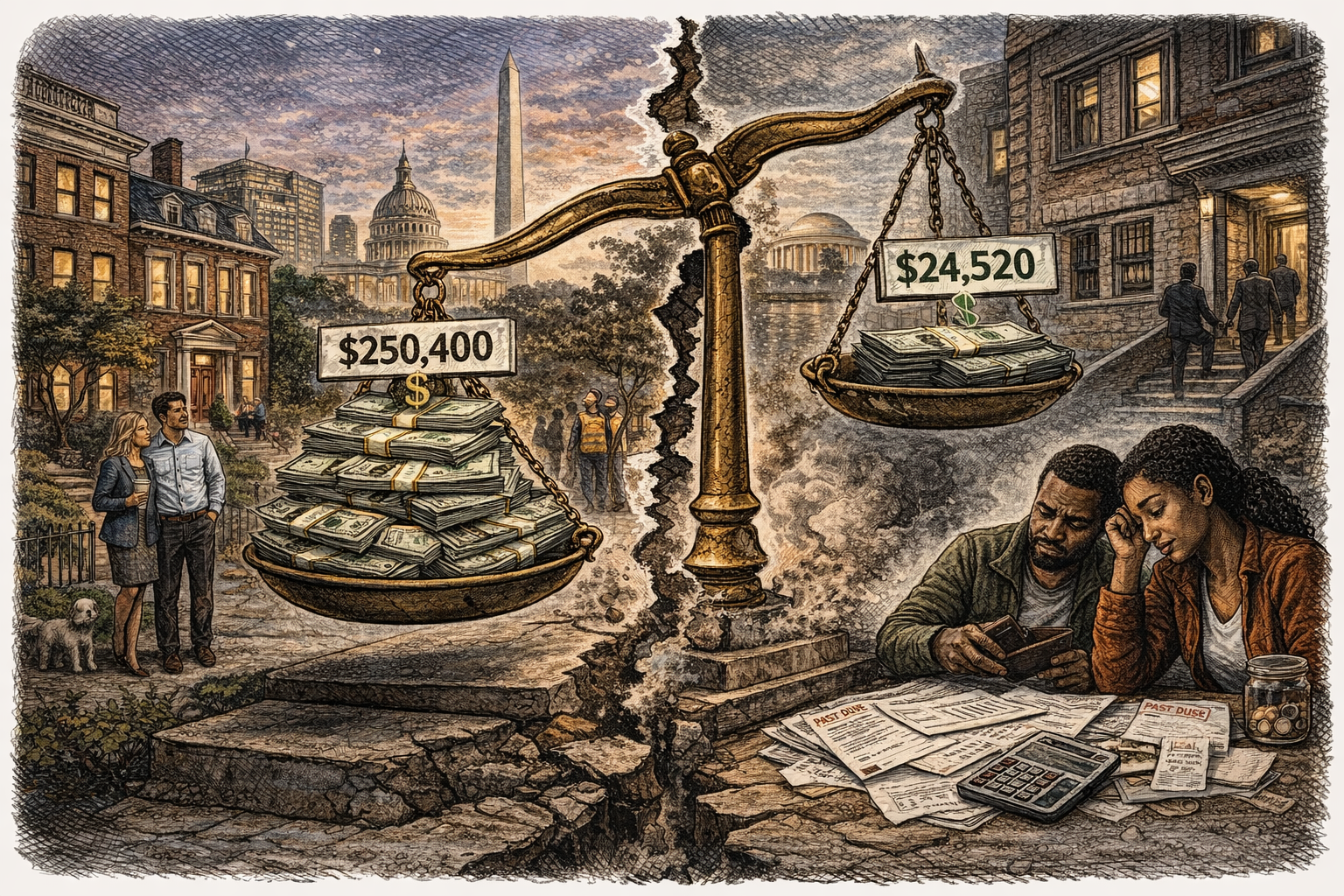
New research released in February 2026 identifies Washington D.C. as having the largest racial wealth gap in the United States. Median white household wealth stands at $250,400. For Black households, the figure is $24,520.
That gap doesn’t emerge from income alone. Wealth captures accumulated advantage over time — home equity, savings, investments, intergenerational transfers — and in D.C., those advantages are distributed along sharply unequal lines even within a city defined by high incomes and a large professional class. High-earning does not mean wealth-building, and the research makes clear why those two are not the same.
Nationally, for every $100 in wealth held by white households, Black households hold approximately $15. That ratio has remained largely consistent despite gains in education and workforce participation over decades — which points to the core finding the research surfaces most starkly.
Black households headed by college graduates hold less median wealth than white households headed by individuals who never completed high school. Education increases income potential. It does not erase differences in starting position, debt burden, inherited assets, or the compounding advantages that begin accumulating long before a degree is earned. The credential narrows the opportunity gap. It does not close the wealth gap underneath it.
In cities like Washington, those dynamics are intensified by housing markets that reward prior asset ownership, federal employment pipelines that have historically offered Black workers stability but limited wealth-building, and rising costs that widen the distance between earning and accumulating. The professional economy is accessible. Wealth accumulation within it is not operating on equal terms.
This is the structural argument beneath the data we’ve been tracking across multiple pieces. As 1.2 Trillion and a Recession at the Same Time examined, aggregate economic indicators can move in a positive direction while the underlying distribution deepens inequality. And as [The Black Recession Has Fresh Numbers] documented, the households most exposed when economic conditions shift are the ones with the least accumulated cushion to absorb it. D.C.’s numbers are extreme. The pattern they reflect is not.
Wealth gaps don’t close through participation alone. They close when the conditions that produce them are directly addressed — and D.C.’s data makes clear how much distance remains between those two things.