
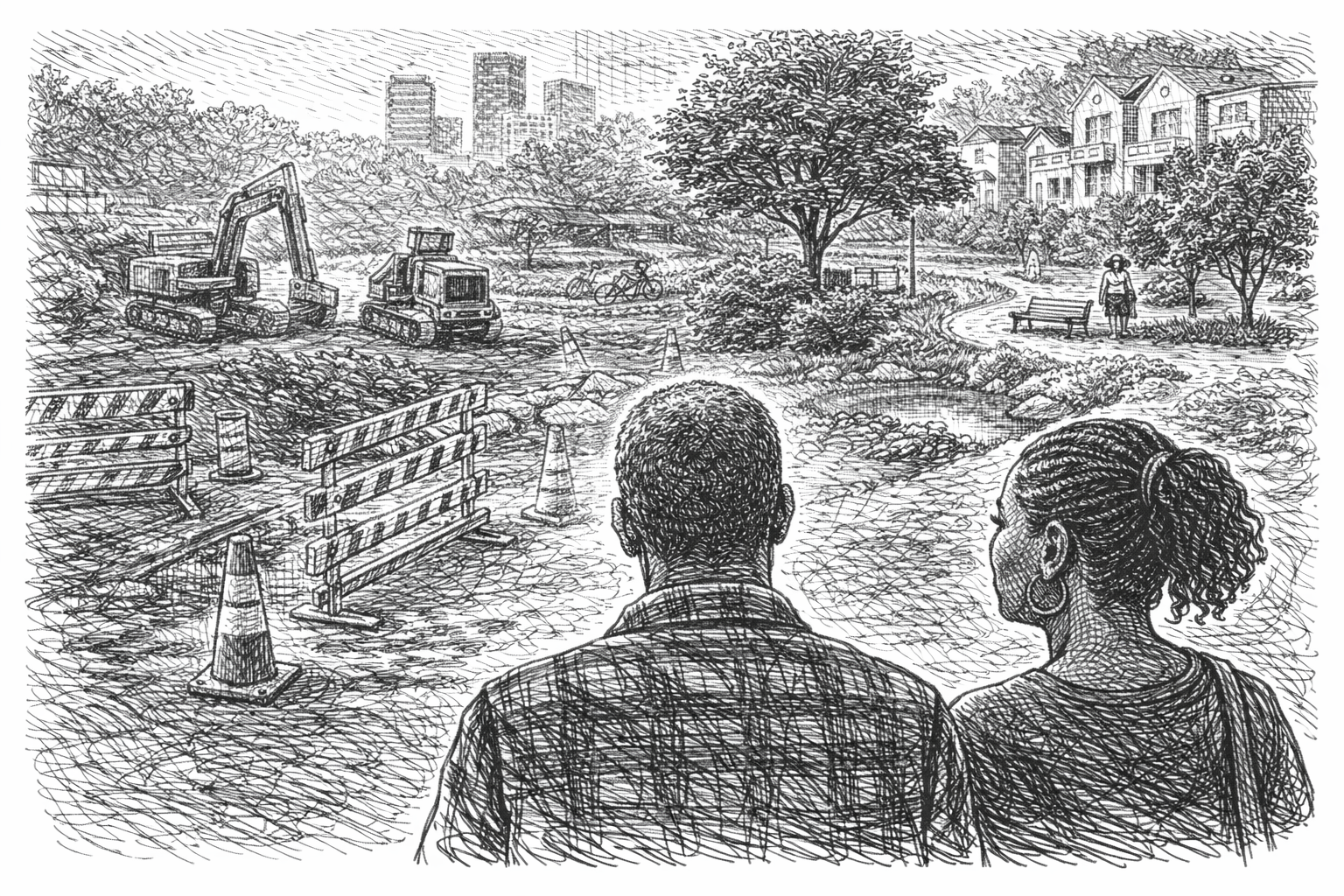
Atlanta knows how to build. The question is who it’s built for.
The city ranks fourth nationally in gentrification-driven displacement, with roughly 22,000 Black residents pushed out over four decades. Neighborhoods like Old Fourth Ward, East Atlanta, and Kirkwood didn’t evolve gradually—they flipped. From 1980 to 2020, 16 majority-Black census tracts lost over 22,000 Black residents while gaining nearly 27,000 white, Asian, and Hispanic residents.
The pattern is familiar: investment drives up property values, and longtime residents can’t afford to stay. What’s changed is the framing. Today, climate infrastructure—parks, flood control, tree canopies—is accelerating the same displacement under the banner of environmental progress.
For some, rising values mean opportunity. For many Black residents, especially renters and those on fixed incomes, it means being priced out. Public investment is making neighborhoods more livable—but not necessarily for the people who lived through their neglect.
Researchers call it climate gentrification. The same communities once most exposed to environmental harm are now being displaced by the solutions meant to fix it.
Atlanta has pledged to create or preserve 20,000 affordable homes by 2026, backed by $1 billion in public, private, and philanthropic funding. That commitment exists alongside the displacement data — not as a contradiction but as an indicator of how wide the gap remains between what cities announce and what communities experience. As we reported in Digital Redlining, access in American cities is increasingly being reshaped not through overt policy but through infrastructure decisions that produce racially disparate outcomes without ever naming race. Climate investment is the newest iteration of that pattern.
The through-line in Atlanta’s story is not malice. It’s priority. When a city decides where to invest, it is also deciding who will be around to benefit. Right now in Atlanta, those are not always the same people — and the gap between them is growing greener by the year.
Atlanta’s transformation isn’t happening in one direction. While Black creators are building new forms of ownership in media — staking claim to narrative, audience, and infrastructure — the city’s physical landscape is shifting in ways that make it harder for Black residents to remain rooted in the place those stories come from. Ownership without geography is partial. A community that controls its image but not its land is still vulnerable in the ways that matter most when the pressure mounts. Black Media Isn’t Just Growing — It’s Building Its Own Infrastructure.
As Tariff Whiplash and the Rising Black Recession documented, the economic pressures on Black households are arriving from multiple directions simultaneously. Displacement from appreciating neighborhoods is one of the quieter ones. It doesn’t show up in unemployment data. It shows up a decade later, in a census tract that no longer looks the way it used to.