
Part of Culture in Motion / The Critic’s Desk — examining how narratives shape perception, power, and public discourse.
From the moment Nick Cannon appeared in Drumline, he reminded us of the corny guy in high school who always wanted to be taken more seriously than the room was willing to allow. He never quite shook that image. And his recent attempt at political commentary on his YouTube show Big Drive is the latest reminder of why.
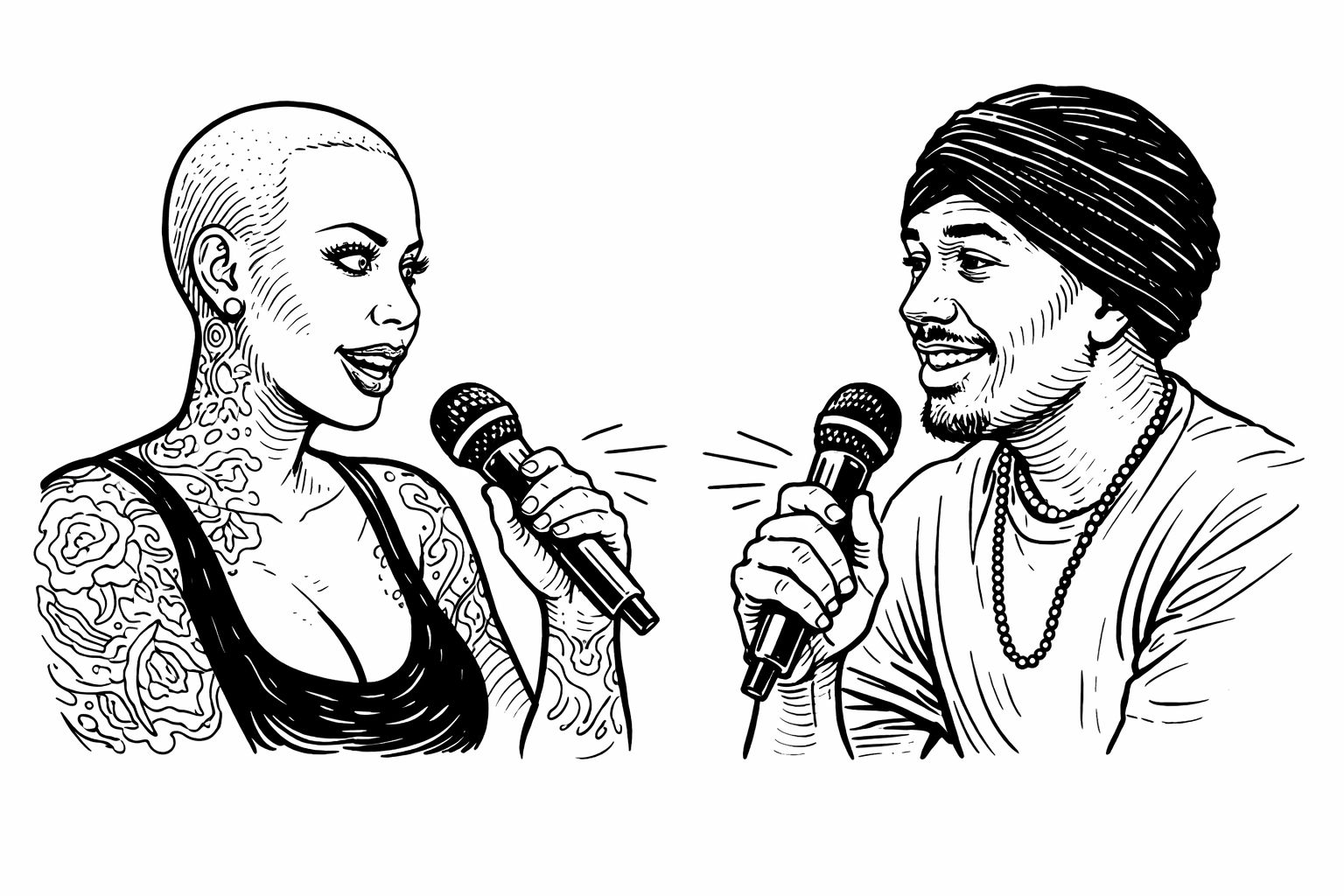
There is a particular kind of statement that thrives in the algorithm: confident, provocative, and just grounded enough in fragments of history to sound credible without actually being accurate. On a recent episode of his YouTube show Big Drive, Nick Cannon provided a textbook example. When his guest Amber Rose said that Democrats “don’t care about people of color and the Republicans do,” Cannon replied: “I agree with you 100%. People don’t know that the Democrats are the party of the KKK. People don’t know that the Republicans are the party that freed the slaves.” He then invoked W.E.B. Du Bois, praised Trump, and positioned himself as a free thinker unbound by either party.
The clip traveled fast. It always does when someone says something that feels like forbidden knowledge.
Here is what makes this moment worth examining rather than just correcting. The historical fragments Cannon cited are real — Reconstruction-era Southern Democrats did have documented ties to white supremacist organizations, and Lincoln was a Republican. What gets left out is that the parties realigned politically in the 1960s when Southern Democrats, known as Dixiecrats, left the party. What followed was the Southern Strategy — a deliberate Republican effort, actively pursued from the 1960s onward, that sought to increase support from white voters in the South by subtly endorsing racial segregation and the disenfranchisement of Black voters. The remaining third of Black Republican voters moved almost unanimously into the Democratic Party in what researchers described as an abrupt shift that has held ever since. The party that freed the slaves spent the following six decades building its majority on the resentment of those who opposed that freedom. Stopping the story in 1865 isn’t history. It’s curation.
The Du Bois invocation is where the performance becomes most revealing. Du Bois’s skepticism of the two-party system was rooted in rigorous structural analysis. What Cannon did was borrow the credibility of that framework while stripping out the rigor that gave it meaning. That is not independent thought. It is the aesthetic of independent thought — the posture without the work. And that posture is doing a specific job right now. Calling yourself a free thinker has become social currency in an environment where institutional distrust runs high and contrarianism is easily monetized. But independence is not defined by distance from political parties. It is defined by rigor. As SSC examined in “White Culture” Was Asked to Define Itself. It Couldn’t. and The Trust Gap — when history is used as a prop rather than a framework, what circulates isn’t analysis. It is mythology with citations, and the algorithm cannot tell the difference.
Why This Matters
This is not just about a celebrity speaking out of turn. It is about how cultural figures participate in political mythmaking — often unintentionally, always consequentially. In a moment when Black political consciousness is being actively contested and reshaped, the cost of confident inaccuracy is not just intellectual. It is directional. It points people away from understanding how power actually moved — and toward a version of history that conveniently absolves the present.