
Part of Society & Technology — an ongoing series examining how technology shapes culture, community, and access.
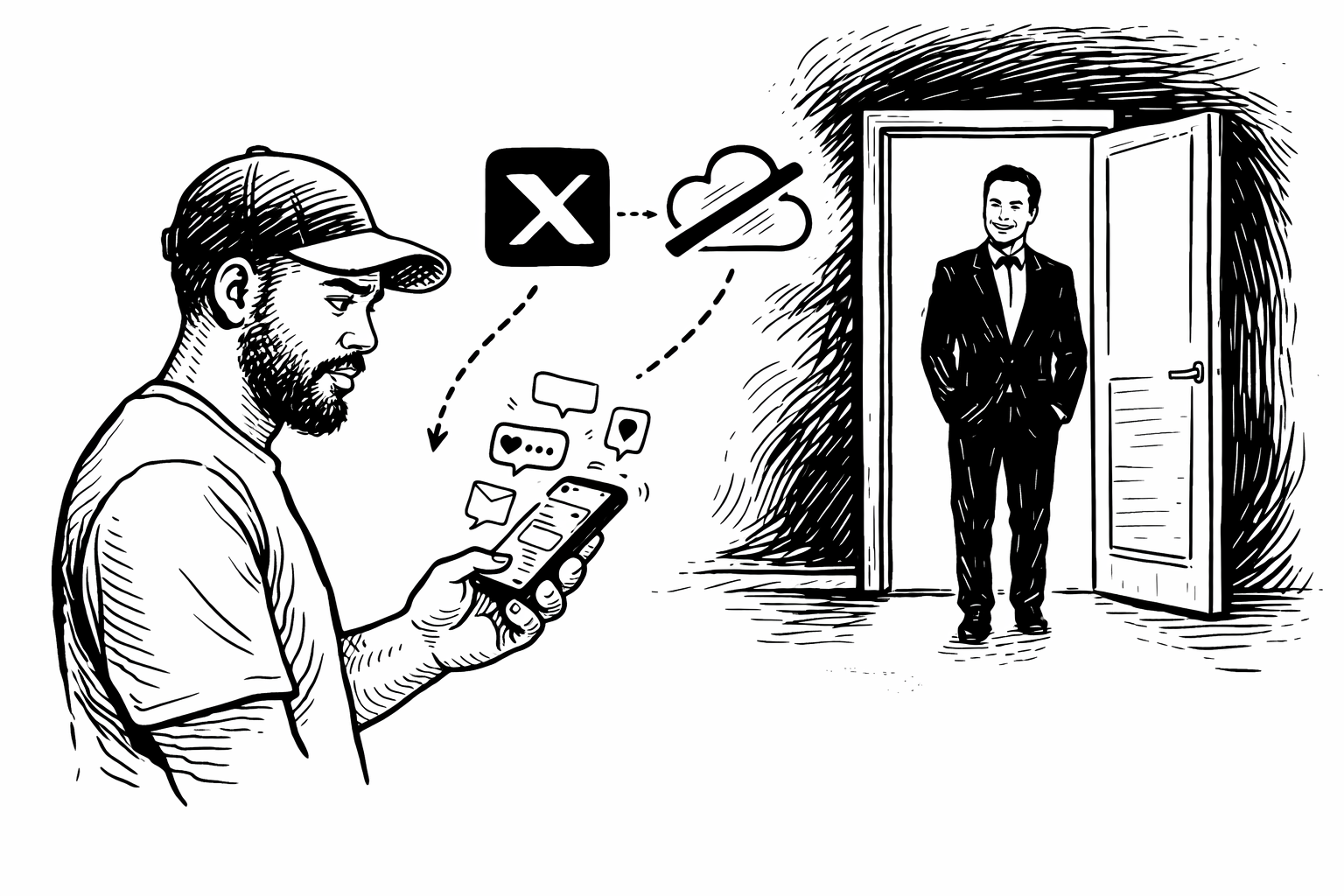
I created a Bluesky account with every intention of making the switch. The reasons were obvious and they were personal. Elon Musk has spent the better part of three years making it clear, through policy changes, amplified rhetoric, and his own feed, that Black users are not the audience he is building for. The platform that once functioned as one of the most powerful spaces for Black cultural and political discourse has been systematically reshaped into something that feels hostile to the communities that built it. I knew this. I still know it. And yet my @mediamastermind account on X, which I created in August 2008, remains where I actually live online.
That tension is not unique to me. It is one of the defining contradictions of Black digital life in 2026.
The celebrity departures were real and they were visible. Don Lemon, Gabrielle Union, and others made public statements about leaving X and establishing a presence on Bluesky. Over a million people joined Bluesky in a single week following the 2024 presidential election, and more than 115,000 X accounts were deactivated in a single day — the highest single-day drop since Musk’s acquisition. The momentum felt different that time. More permanent. And yet the mass migration that seemed inevitable never fully materialized among everyday Black users, even as the reasons to leave kept accumulating.
The question worth sitting with is why. And the honest answer is more complicated than habit.
Part of it is infrastructure. As one user put it plainly: “Twitter is where I mobilize my community. It’s where I made tons of different connections, and that’s where everything started for me and my business.” That’s not nostalgia — that’s a network that took years to build. Followers, relationships, institutional memory, cultural context — none of it transfers automatically. Starting over on Bluesky means starting from zero, and for Black creators, organizers, and communicators who built real audiences on X, that cost is not abstract. It’s professional and personal all at once.
Part of it is the platform itself. Bluesky is cleaner and its community moderation tools are genuinely better — users can report violations directly to moderators for swifter action, and tools like Blacksky, a curated collection of Black-centered feeds built by developer Rudy Fraser, actively filter out racism and misogyny in ways X never prioritized. But vibrant is not the same as safe, and Bluesky, for all its promise, still doesn’t feel like a room that’s full yet. The conversation isn’t there at the same volume. The cultural pulse that made Black Twitter feel like a living thing hasn’t been replicated, and showing up to a quieter room every day eventually stops feeling worth it.
And part of it — the part that’s hardest to name — is that X still works. Despite sustained criticism and ongoing user migration, X remains the largest platform with an estimated 611 million active users in 2025, generating an average of 328 engagements per post compared to Bluesky’s 21. The reach is still there. The moments still happen there first. The algorithm, for all its distortions, still surfaces Black content in ways that drive cultural conversation. Leaving means opting out of that reach, and in a media environment where visibility is currency, that’s a significant ask.
What this moment reveals is something SSC examined in Black Twitter Was Infrastructure — the platform was never just a product Black users consumed. It was infrastructure they built. And infrastructure, once built, is extraordinarily hard to abandon even when the landlord changes the locks and starts letting in people who don’t respect the building. The sunk cost isn’t just time. It’s community, identity, and years of cultural labor that have no clean export function.
This is also where Elon’s behavior becomes most damaging in ways that go beyond the obvious. It’s not just that he has created a hostile environment. It’s that he has created a hostile environment that Black users are still economically and socially incentivized to remain in. The harm and the dependency exist simultaneously, and that tension — staying somewhere you know doesn’t want you because leaving costs too much — is not a new experience for Black Americans navigating institutions built for someone else.
I’m still on X. I still check Bluesky and find it quieter than I need it to be. And I’m still not sure which direction this resolves — whether the scale tips toward departure when the cost of staying finally outweighs the cost of leaving, or whether X holds because the network effect is simply too powerful to overcome.
What I do know is that the question of why we haven’t left is more interesting than the question of whether we should. The answer lives at the intersection of infrastructure, economics, identity, and a platform that understands, even if its owner doesn’t, that Black users are not optional to its survival.
Why This Matters
The decision to stay on a platform that has signaled its indifference — or worse, its hostility — to Black users is not passivity. It is a calculation made under real constraints. Until an alternative can offer comparable reach, comparable community, and a viable path to rebuilding what already exists, the migration will remain incomplete. The platforms that want Black users need to understand that the ask isn’t just technical. It’s cultural, relational, and economic — and meeting it requires more than a cleaner interface and better moderation tools. It requires being worth the cost of starting over.