
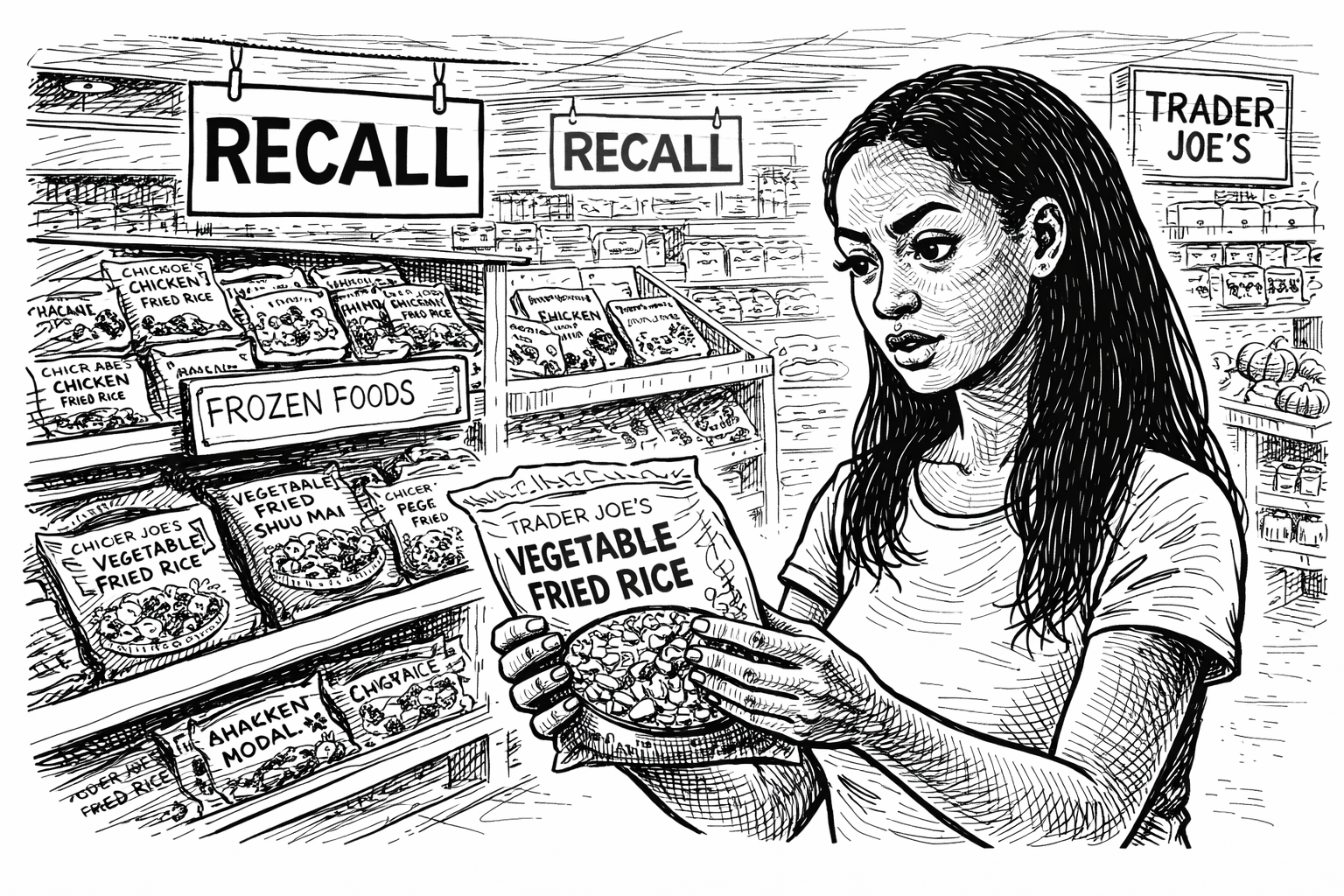
I go to Trader Joe’s about twice a month. It’s predictable in a way that feels intentional — the same frozen aisle rotation, the same few staples, the same sense that I know what I’m getting. So when I saw the recall alerts this week, it didn’t feel abstract. It felt like something that could already be in my freezer.
This wasn’t a small recall. It started with a few frozen fried rice products and expanded into a much larger issue tied to more than 47 million pounds of food across multiple brands, including several Trader Joe’s items. The concern wasn’t labeling or packaging. It was glass — fragments traced back to a vegetable ingredient, specifically carrots used in the production process. Four core Trader Joe’s products were pulled: Chicken Fried Rice, Vegetable Fried Rice, Japanese Style Fried Rice, and Chicken Shu Mai, all with best-by dates running through late 2026. These weren’t fringe items — they were freezer staples for a lot of people.
Standing in my kitchen, I didn’t panic. I checked the freezer. I looked at dates. I threw one bag out just to be safe. That part was straightforward. What stayed with me wasn’t the inconvenience — it was the realization of how much trust is built into something as routine as grocery shopping.
Trader Joe’s operates on a model of curated simplicity: fewer choices, private label products, a sense of quality control that feels tighter than a traditional grocery store. But this recall was a reminder that the supply chain behind that simplicity is anything but simple. The issue didn’t originate in the store. It came from a supplier — one that also produces food for multiple brands. That’s the part most people don’t think about. The same manufacturer can sit behind Trader Joe’s, Kroger, and other labels at the same time. So what feels like a brand-level experience is often a shared infrastructure. When something breaks in that system, it doesn’t stay contained. It scales.
To Trader Joe’s credit, the response followed a familiar pattern: pull the product, advise customers to discard or return it, move quickly. That’s what a recall is supposed to look like. But recalls are reactive by design. They happen after something has already entered the system. And in this case, the products had already been distributed across more than 40 states. That gap — between production and detection — is where the real risk lives.
What this week clarified for me is that convenience is built on trust, and trust is built on systems we rarely see. I’ll still go to Trader Joe’s. I’ll still buy the same things. But there’s a subtle shift now — a pause, a label check, a reminder that the experience in the aisle is only the final step in a much longer chain. The food didn’t change. My awareness of the system behind it did.