
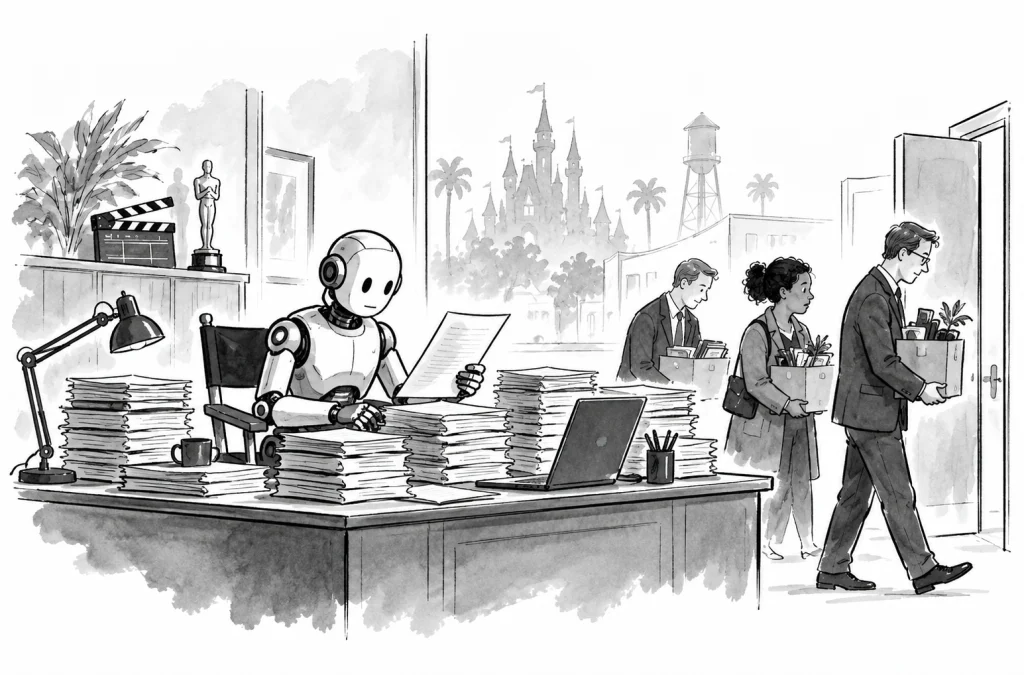
A memo warned the legal department it would shrink. A week later, Disney advertised the role that will design what replaces it.
Most corporate AI announcements describe tools. Disney’s clearest statement about how it plans to use artificial intelligence came as a job listing.
On September 18, Horacio Gutierrez, Disney’s chief legal and global affairs officer, sent a memo to his department warning of a “transformation process” and “hard choices.” He listed automating workflows with the latest technologies, moving to self-service models, bringing in alternative legal providers and outsourcing. “LGA will be a much smaller organization than it is today,” he wrote, adding that some staff would be personally affected. The department has just under 1,000 employees worldwide.
The memo never mentioned AI. The job posting that followed a week later made the connection clear.
Reading the spec
Disney is hiring a director of AI enablement and legal engineering. According to The Hollywood Reporter, the role will redesign legal workflows around AI systems and deploy technology for contract review, legal research and regulatory analysis. It also calls for deciding whether Disney should build its own AI systems or buy them from vendors, measuring return on investment and helping lawyers adopt new workflows.
That description works like a technical roadmap. It names three use cases, sets up a build-versus-buy decision, requires the system to justify its cost and treats lawyer adoption as something to be managed. This isn’t a company handing employees a chatbot. It’s a company redesigning a department around the software, then deciding how many people the new design needs.
That’s the shift worth watching in enterprise AI. The first wave was about access: licenses, copilots, pilot programs. The second is about architecture, meaning which steps in a process get handed to a model, which move to self-service and which stay with a person. Chief Financial Officer Hugh Johnston described that shift on the company’s May earnings call. “We’re using technology to fundamentally change how work gets done,” he said, a month after Disney cut roughly 1,000 jobs across studio and TV units.
Why legal goes first
Legal work is where this redesign tends to start because parts of it are more structured than they look from outside. Contracts follow templates, clauses repeat and review follows a playbook. That makes the function a natural early target.
The industry data points the same way. In a December survey of 452 in-house legal professionals by LegalOn and In-House Connect, 52 percent of teams said they were using or evaluating AI for contract review, with active use nearly quadrupling since 2024. Respondents reported spending an average of 3.1 hours reviewing a single contract. And 78 percent said they were comfortable letting an AI agent do first-pass contract review under attorney supervision.
That last number describes the model Disney’s memo seems to anticipate. The AI drafts and flags. A smaller number of lawyers supervise. The “self-service” piece of the memo fits a broader trend of contract tools that let sales or procurement staff handle low-risk agreements on their own with AI guidance, pulling routine work away from lawyers entirely.
The supervision problem
This model depends on something the org chart may not protect. Supervised delegation only works if the supervisors can recognize when the AI is wrong. That judgment comes from years of doing the work the AI now handles, the first-pass reviews and routine research that have traditionally trained junior lawyers. If a department shrinks from the bottom, it keeps today’s experienced reviewers but loses the pipeline that would have produced the next ones.
There’s also a structural irony. The Hollywood Reporter noted that Disney’s use of AI in production has been slowed by legal constraints, including unresolved copyright and ownership questions. The department responsible for managing AI risk is shrinking as the company expands its use of AI. That doesn’t make the plan wrong, but it means the team that evaluates AI’s legal exposure will be smaller at the moment that exposure is growing.
A company reorganizing around a technology bet
The timing links the legal memo to a larger strategy. It went out the same day Disney named Karandeep Anand, the former CEO of Character.AI, as its first chief technology officer, reporting directly to CEO Josh D’Amaro. It also landed as a deadline approached for Disney’s voluntary early retirement offer, which was expected to be followed by involuntary layoffs.
Disney told investors in August it remains focused on cutting costs across the company, and its stock is down nearly 40 percent since 2021. Gutierrez tied the changes to D’Amaro’s vision of breaking down internal walls and embracing technology instead of holding on to old ways of working.
The broader lesson for anyone tracking enterprise AI is where to look. Earnings calls speak in general terms and memos avoid naming the technology. The job descriptions for the people hired to rebuild the work are usually the most specific public document a company produces about what it plans to automate, and in Disney’s case, the posting says more than the memo did.
Sources: The Hollywood Reporter, Deadline, LegalOn Technologies, Artificial Lawyer, Code & Counsel