
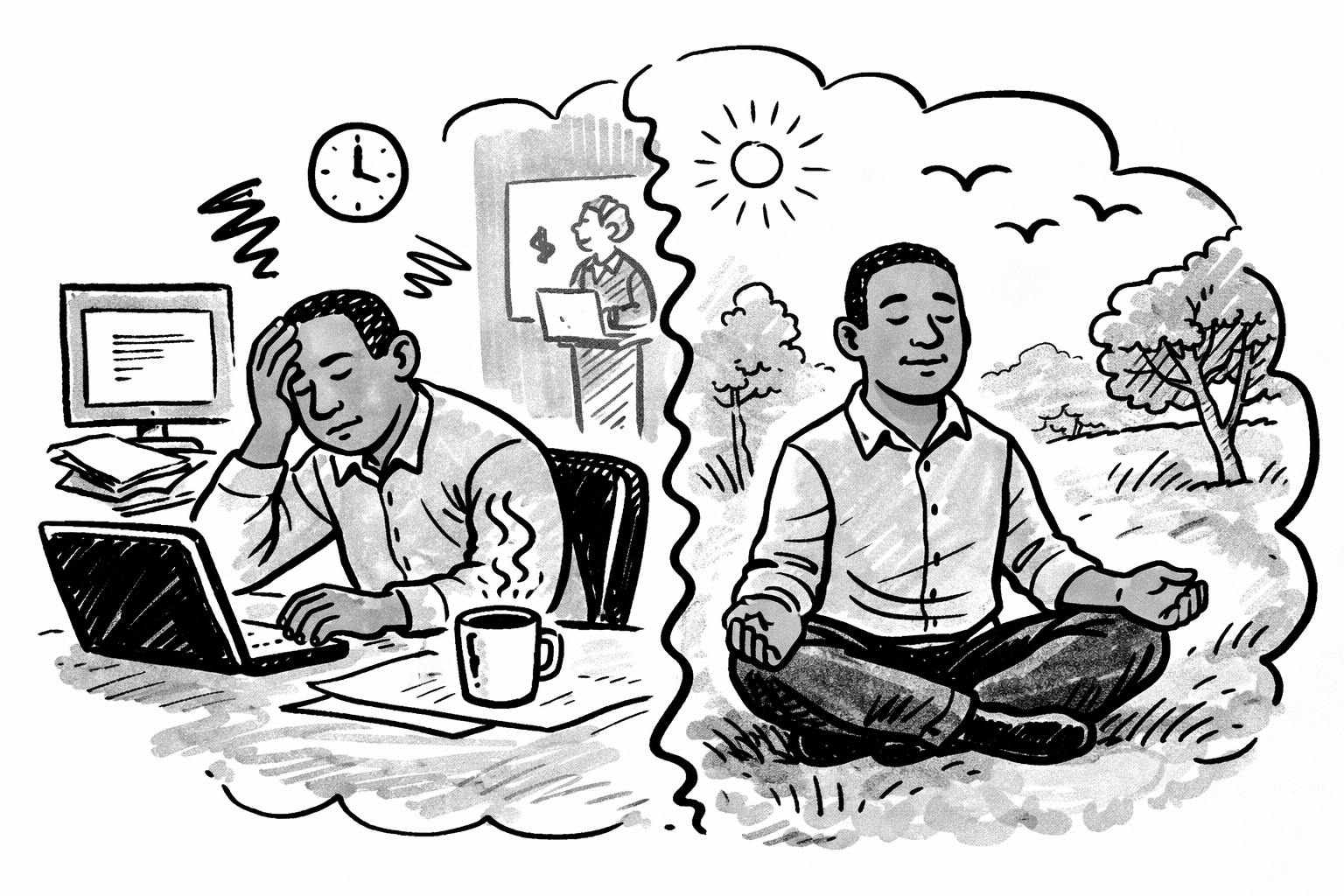
Part of The Inner Work — an ongoing series on intentional living, mental clarity, and the quiet practices that sustain us.
According to the American Psychological Association, chronic workplace stress doesn’t just affect mood — it activates the body’s stress response system in sustained ways that can lead to burnout, anxiety, disrupted sleep, and long-term physical health issues. What begins as a difficult job or tense environment can, over time, become a constant physiological state. The body stops distinguishing between occasional stress and everyday life. It adapts, but not in a way that restores balance — in a way that normalizes strain.
That distinction matters because most conversations about burnout focus on coping rather than cause. Therapy, mindfulness, and stress management tools are valuable — but they are designed to help regulate your response to stress, not eliminate the source of it. When the environment itself remains unstable, high-pressure, or psychologically unsafe, the nervous system is repeatedly pushed back into activation. Progress becomes cyclical. Relief becomes temporary.
This is where a shift in environment changes the equation. When individuals remove themselves from a chronically stressful workplace, the nervous system is no longer being triggered at the same frequency or intensity. The body has space to recalibrate. Sleep improves. Baseline anxiety decreases. Emotional responses become less reactive. What feels like healing is often the result of something more foundational — the removal of constant disruption. As Nothingmaxxing Is Being Framed as Modern Meditation explored, the practices that actually help people recover require the one thing a chronically stressful environment is least willing to provide — genuine permission to be still. That stillness only becomes available once the source of activation is no longer present.
This doesn’t mean leaving a job replaces therapy, or that one is more effective than the other. They serve different roles. Therapy helps process experiences, build awareness, and develop tools for long-term resilience. But those tools work best when they are not being used in a constant state of defense. As Closure Is Something You Give Yourself examined, healing often involves an internal decision rather than an external event — the moment when someone decides that the past will no longer occupy the center of their emotional life. Leaving a stressful environment is that same decision applied to the present. Without it, growth often feels like maintenance. With it, it becomes momentum.
The broader insight is uncomfortable but clear: not all stress is meant to be managed. Some of it is meant to be removed. The difficulty is that chronic stress environments rarely announce themselves as unsustainable in the moment — they become normalized through routine, responsibility, and the quiet belief that things will improve with time. Often, they don’t. What changes instead is your tolerance.
The question becomes less about whether you can handle it, and more about what it is doing to you over time. If your baseline has shifted — if exhaustion feels constant, if rest doesn’t restore you, if your body feels like it’s always on — it may not be a signal to cope better. It may be a signal that something in your environment needs to be reconsidered.
The most important question isn’t how to manage the stress. It’s whether you’re still willing to live inside it.