
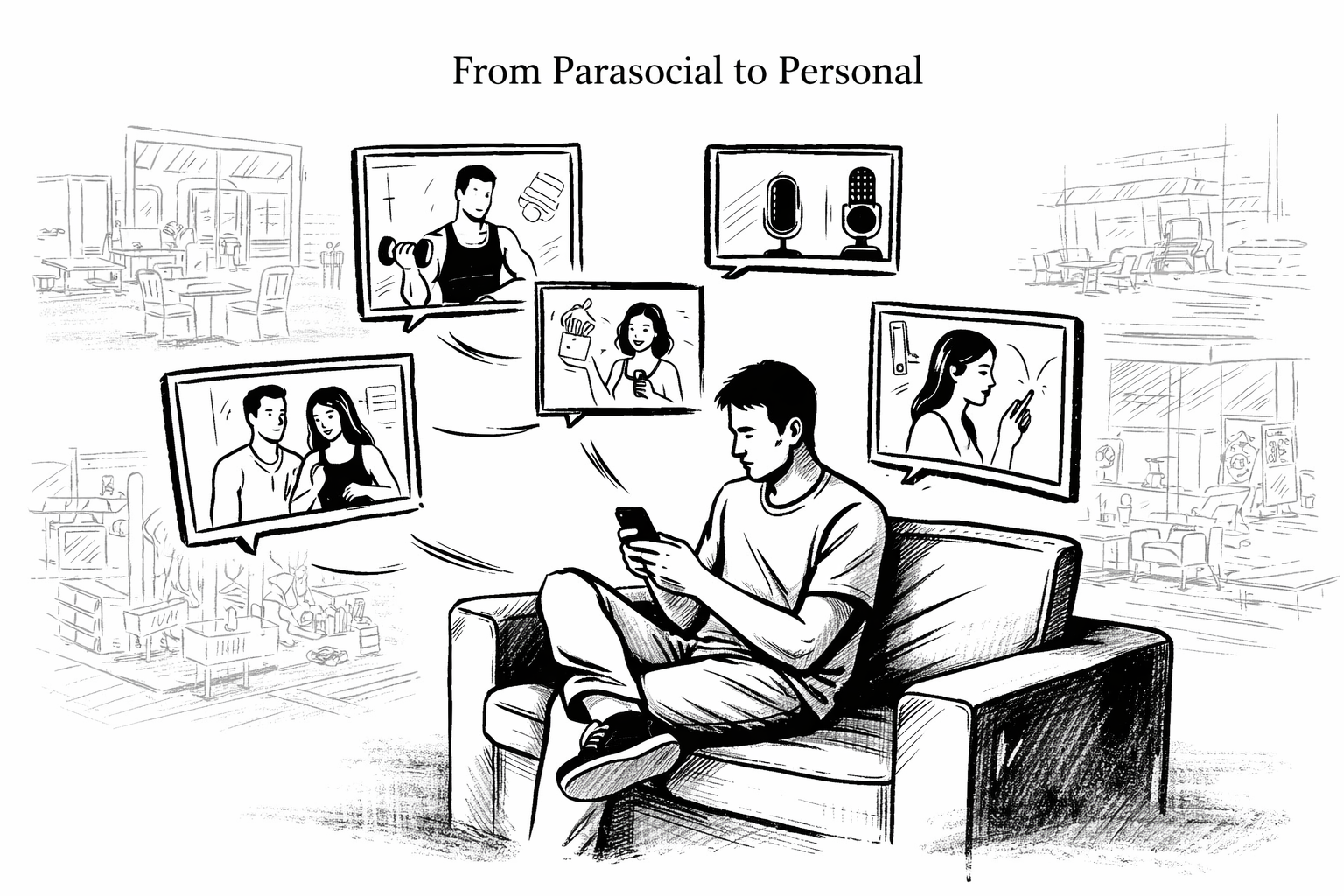
The small decisions pile up without announcing themselves.
Stream a workout at home instead of going to the gym. Order groceries through an app instead of walking the aisles. Text instead of call. Scroll instead of meet. Each choice feels practical — efficient, reasonable, low-friction. Taken together, they point toward something larger: the spaces that once structured daily interaction are quietly becoming optional, and something is moving in to fill the gap.
What’s filling it is people. On screens. Creators, influencers, personalities who show up daily in formats that feel intimate and consistent. Over time, those repeated interactions begin to feel familiar — not in a distant, celebrity-worship sense, but in a way that starts to resemble something closer to relationship. Psychologists call this a parasocial bond: a one-sided connection where the audience develops a genuine sense of familiarity with someone who doesn’t know they exist. What was once limited to television has become constant, portable, and deeply woven into everyday life.
The scale of the shift matters. A growing number of younger audiences report feeling emotionally connected to creators they follow — with some research suggesting that trust in influencers can rival, and in certain cases exceed, trust in traditional institutions. That kind of influence doesn’t just shape purchasing decisions. It shapes how people think, how they present themselves, and what they come to believe is normal, desirable, or possible.
You can see it in the details. Morning routines that become templates. Fitness habits that evolve into identity markers. Dating standards shaped less by lived experience than by viral clips, podcasts, and curated conversations. Concepts like “looksmaxing” or highly specific relationship checklists don’t emerge in isolation — they are learned, repeated, and reinforced within digital ecosystems where the line between observing a behavior and adopting it has become very thin.
Sometimes these one-sided relationships don’t stay personal — they become collective. Fan communities form around single figures, developing their own language, norms, and loyalties. The Barbs, the Beyhive, the Navy, the Swifties — these are not simply audiences. They are organized social formations that mobilize around their subject’s reputation, narrative, and perceived slights. What begins as admiration can shift quickly into defense — active, coordinated, and sometimes aggressive. The parasocial bond may be one-sided. The responses it generates are often very real.
Meanwhile, the physical spaces that once provided a different kind of connection — the café, the gym, the plaza, the mall — are becoming increasingly optional. These were never just functional environments. They were places where unpredictability existed, where conversation could happen without being initiated, where difference was encountered without being sought. Replacing them with controlled, individualized, on-demand experiences may feel like efficiency. It also narrows the range of how we actually encounter each other.
None of this is inherently negative. Parasocial relationships can inspire, inform, and provide genuine comfort. But as they deepen — as creators become more present in daily life than many people we know in person — a quieter question surfaces: are we choosing convenience, or are we gradually redefining what connection means? And if the people most consistently shaping our identities, our standards, and our sense of what’s possible are people we will never actually meet — what do we gain from that, and what quietly disappears?