
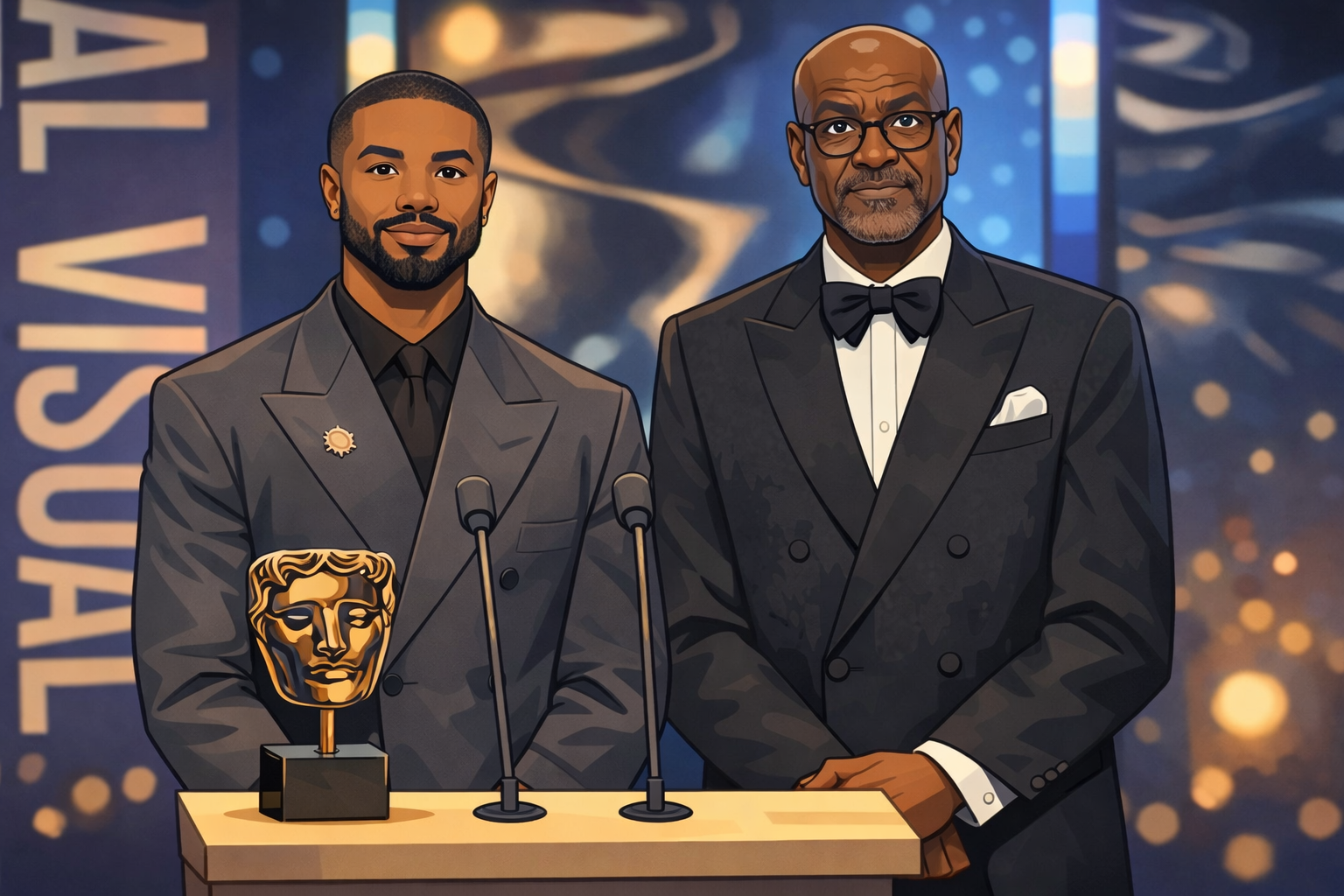
Addendum (March 15, 2026): Just hours before this essay was scheduled for publication, Michael B. Jordan won the Academy Award for Best Actor for his performance in Sinners. The moment marked a historic milestone in his career and adds an additional layer of reflection to the cultural conversation explored below.
Award shows are designed to celebrate art, but occasionally they reveal something deeper about the culture watching them.
Earlier this year, an exchange at an international awards ceremony in London involving Michael B. Jordan and fellow actor Delroy Lindo included a racial slur. The moment circulated quickly online, drawing attention not only for what was said but for the institutional decision that allowed viewers to experience it in real time. The individual involved reportedly lives with disabilities, which prompted calls for compassion and understanding. Many viewers responded with empathy, recognizing that disability can shape how people communicate and interact with the world. That empathy is appropriate. But compassion and accountability are not mutually exclusive values. Both can exist at the same time.
What made the moment especially unsettling for many viewers was the decision to allow the exchange to air unedited. Broadcasters routinely build delays into live programming precisely to prevent harmful or inappropriate language from reaching audiences. When those safeguards fail — or are simply not used — it raises a reasonable question about responsibility. The issue, ultimately, is larger than any one individual.
Both Jordan and Lindo represent the very best of Black American excellence. Their careers span decades of work that has shaped film, television, and cultural storytelling. For many viewers, they are not simply actors — they are cultural figures we admire and celebrate. Which is why watching them stand in that moment, unprotected, struck such a nerve. As a Black American man myself, I watched it unfold in disbelief. What I felt can best be described as a kind of secondhand trauma — a reminder that racial language directed at us can still appear in public spaces without immediate intervention. Seeing two respected Black actors placed in that moment made the discomfort feel personal.
It is possible to extend compassion to someone navigating disability while also acknowledging the harm caused by racial slurs. Respect for one group’s dignity should never require dismissing another’s. Editing a slur from a delayed broadcast would not have been an act of censorship — it would have been an act of care for everyone involved. Instead, the decision to leave the moment intact forced viewers to grapple with a difficult tension that institutions, not individuals, created.
The contrast became even more visible a week later at the NAACP Image Awards. In that room, both actors were celebrated and embraced in a way that felt unmistakably different. Surrounded by a community that understood their cultural significance, the atmosphere carried a sense of safety and affirmation that many viewers recognized immediately. During his remarks, Jordan shared a simple but powerful sentiment: he loves being Black. The line landed with warmth and applause — not because it was controversial, but because it reflected the comfort of standing in a space where his identity was not being questioned or diminished.
A healthy society must be capable of holding multiple truths at once. People with disabilities deserve compassion and dignity, and Black men deserve protection from racial slurs in public spaces. Neither principle should require sacrificing the other. The real lesson from this moment is not about assigning blame — it is about recognizing how easily institutions miss opportunities to protect the dignity of everyone in the room. How do we create spaces where compassion for one group never requires silence from another?
That is the question worth sitting with.