
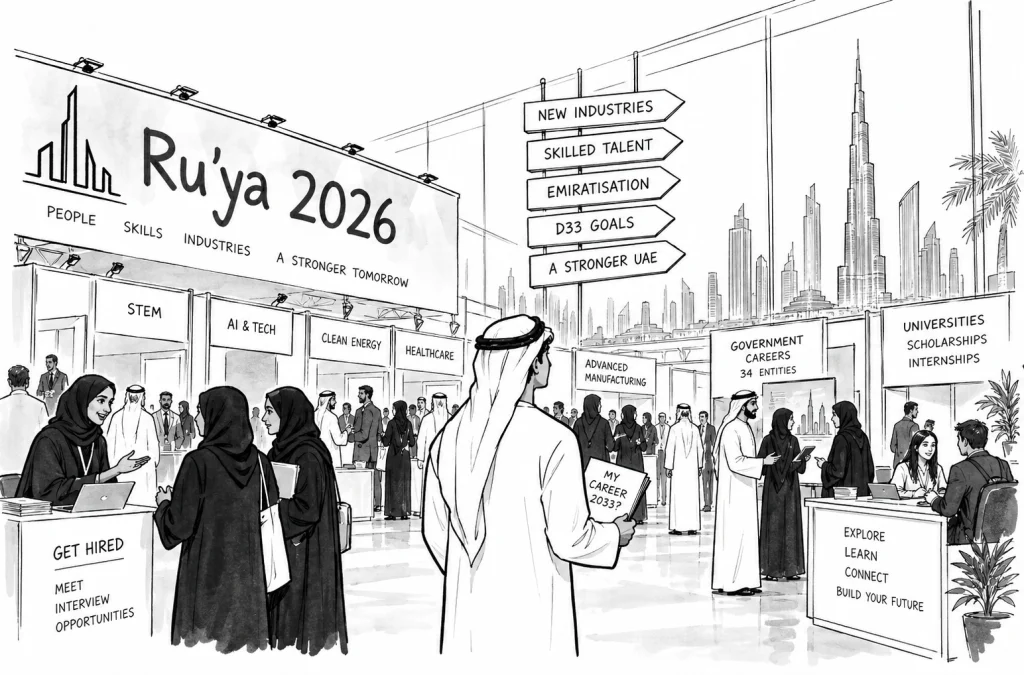
Ru’ya 2026 brings more than 150 employers together with young Emiratis this week. The harder question is whether the matching can keep up with the economy Dubai is building.
When the doors open Monday at Dubai World Trade Centre, thousands of young Emiratis will find more than 150 employers across more than 23 sectors in one hall. Ru’ya 2026, running September 28 to 30, is built for students, recent graduates and early-career professionals, with programming in STEM, entrepreneurship and future-of-work skills.
It’s the latest edition of a long-running event. Organizers say Ru’ya has supported the national talent agenda for 25 years and now describe it as a national platform tied to Emiratisation, future skills and lifelong career development. What has changed is the scale of the economy it is trying to staff, and how much policy now sits behind the matching.
More than a job fair
The format reflects a shift from recruiting to routing. A dedicated “Get Hired” platform lets employers meet shortlisted Emirati candidates and interview them on site. An Academic Hub, supported by Dubai’s education regulator KHDA, connects students with universities, majors, scholarships and internships, linking academic choices to later careers. The Dubai Government Human Resources Department is bringing 34 government entities under a single platform.
Asma Al Sharif of Dubai World Trade Centre pitched it as a place for young people still figuring out their direction. Visitors, she said, “don’t need to arrive knowing exactly what you want to do,” and may leave having found an industry or path they hadn’t considered.
That openness is the event’s selling point. It is also a clue to the problem it is trying to solve.
The economy moves faster than the pipeline
Dubai’s economic agenda, D33, aims to double the economy by 2033 through 100 transformational projects, including a sandbox for testing new technologies and a program to build 30 companies into global unicorns in new sectors. The same plan commits to bringing 65,000 young Emiratis into the job market.
Those two goals run on different clocks. A government can license a new sector, fund a free zone or launch a program in months. Building the workforce for it takes years of schooling, training and early-career experience. UAE employers are already reporting shortages of AI, cloud and machine learning talent as demand grows. A student who picks a major this week at Ru’ya will graduate into an economy that has moved on from where it stood when they chose.
Quotas create demand. Matching still has to happen.
The UAE doesn’t leave Emirati hiring to the market. Private companies with 50 or more employees must raise the share of Emiratis in skilled roles by 2 percentage points a year, reaching 10 percent by the end of 2026. Missing the target costs AED 9,000 a month for each unfilled position, and smaller firms with 20 to 49 employees in 14 targeted sectors face their own requirements. The Nafis program offsets the cost by topping up Emirati salaries and sharing pension contributions, and it has been extended to 2040.
The results show on paper. More than 190,000 Emiratis now work in the private sector, and 95 percent of companies subject to the rules met their targets in the first half of 2026, according to Khaleej Times.
But quotas measure headcount, not fit. A “skilled” role under the rules requires a diploma or higher and a salary of at least AED 4,000 in one of five broad occupational categories. That definition counts whether a company hired an Emirati. It doesn’t track whether the hire landed in the AI, data and advanced manufacturing roles D33 is prioritizing. The ministry’s zero-tolerance campaign against fake Emiratisation suggests some employers have treated the quota as something to satisfy rather than a pipeline to build.
The placement data hints at the gap. Women make up 74 percent of Nafis beneficiaries, and in 2025 Emirati women held 94.1 percent of Emirati private-sector education jobs and 91.2 percent of healthcare roles. Those are essential sectors, but they aren’t the ones D33 is racing to build. The pipeline is producing jobs. It isn’t yet clear it’s producing the jobs the new economy says it needs.
What Ru’ya can and can’t do
A careers fair can shorten the distance between a graduate and an employer. It can’t close the gap between an industry that didn’t exist three years ago and a degree program designed before it did. That work happens earlier, in curriculum, apprenticeships and employers willing to train people for roles still being defined.
Dubai is attempting something most economies do in sequence: creating industries and supplying their workforce at the same time, with quotas to force demand, subsidies to lower the cost and events like Ru’ya to make the introduction. Whether that works will depend less on how many employers fill a hall this week than on where the young Emiratis in that hall are working in 2033.
Sources: mid-east.info (Ru’ya 2026 release), WAM, UAE Today, Zawya, UAE Government (D33), Khaleej Times, UAE Expert Hub, Adecco, Gulf News, Dubai Standard