
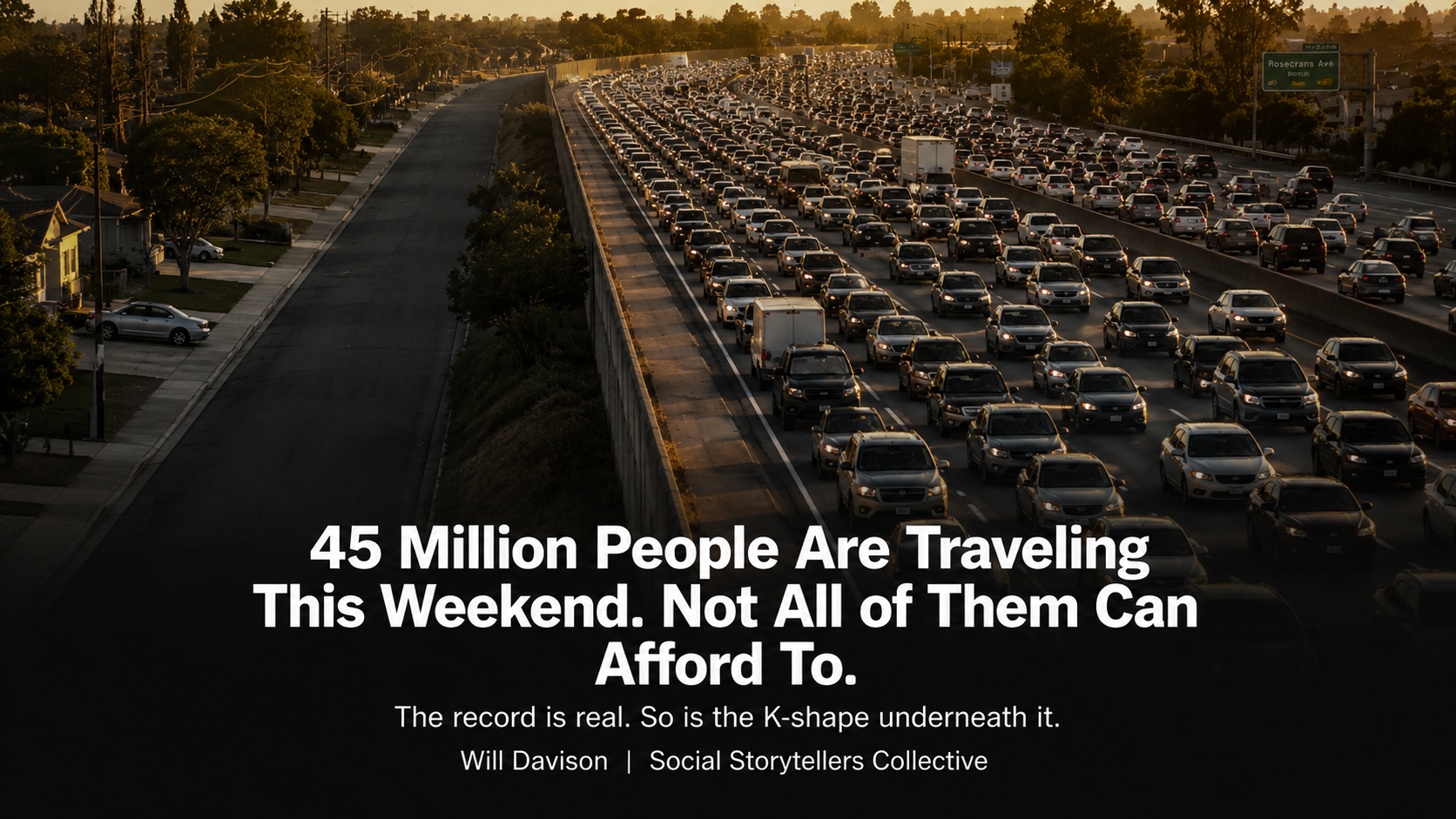
The highway signs lit up Thursday morning. Orange construction warnings. Digital countdowns. EXPECT DELAYS — MEMORIAL DAY WEEKEND TRAFFIC. At every major airport, TSA lines stretched past the retractable barriers and into the terminal corridors before 7 AM. Forty-five million people are on the move this weekend. It is, by AAA’s count, the busiest Memorial Day weekend in recorded history.
The number is real. The celebration around the number is the part worth examining.
What the Record Actually Measures
AAA projects 45 million Americans will travel at least 50 miles from home between Thursday and Monday — a new Memorial Day record, edging out last year’s 44.8 million. The vast majority, roughly 39.1 million people, are going by car. Another 3.66 million are expected to fly, with roundtrip domestic tickets averaging $800 — down 6% from last year for those who booked early, before jet fuel prices started climbing again. The headline is clean. Americans are traveling in record numbers. Summer is back. The economy is moving.
Here is the number that doesn’t make the headline: according to Bank of America’s 2026 Summer Travel Outlook, nearly 40% of households earning $66,000 or less have no summer travel plans at all. Zero trips. Not scaled back — none. Their travel-related card spending is down year over year. Meanwhile, middle- and higher-income households are increasing their travel spending. The K-shape that has defined the post-pandemic economy is now showing up in where people go — and in who gets to go anywhere at all.
The Cost of Getting There
The math for lower-income households is unforgiving this weekend. The national average for a gallon of regular gasoline sits at $4.53 — up roughly 40% from this time last year, when it was $3.19. For the median lower-income household, Bank of America’s data shows that gasoline now consumes 4.2% of monthly income, up from 3.9% a year ago. That fraction sounds small until you do the arithmetic on a tank of gas for a 400-mile round trip. And then another tank. And then the hotel. And then the food.
The personal savings rate has dropped to 3.6% — the lowest level since 2022 — as households draw down whatever cushion they built during the early post-pandemic years. Credit card balances are climbing. NerdWallet’s Travel Price Index shows that overall travel costs in April 2026 rose 7.8% year over year, more than double the 3.8% rate of general inflation. The divergence between travel cost inflation and general inflation is not a rounding error. It is a structural feature. Travel has become a sector where the costs are outpacing everything else — and the people most sensitive to those costs are the ones the record headline is not counting.
Who the Record Is Counting On
The 45 million figure does not represent 45 million evenly distributed Americans. It represents the households that can absorb $4.53 gas, or who booked flights months ago when prices were lower, or who have the savings buffer to handle a long weekend that runs over budget. Over 60% of higher-income households had their summer travel plans locked in by early April, per Bank of America. About 80% of lower-income households that aren’t traveling cite affordability concerns or economic uncertainty as the reason.
What that creates is a record that reflects the top of the income distribution consuming more while the bottom stays home. That’s not a critique of people who travel — it is a structural observation about what “record travel” means in an economy where the savings rate is near a four-year low and inflation is hitting necessities and leisure costs simultaneously. The record is being set by one America. The other America is watching the highway signs from where they are.
The travel industry’s Memorial Day framing is always aspirational — peak season, summer kickoff, the unofficial start of something. That framing does real work. It makes record travel look like a sign of collective economic health, a shared national exhale. But the Bank of America data underneath the AAA headline tells a different story: a K-shaped travel season, a divided road, a record that requires you to ask who’s in the 45 million and who got counted out before the weekend started.
The timing matters too. This record is announced on the same Friday that the House passed a budget bill that will, if it becomes law, remove millions of lower-income Americans from Medicaid. The people who aren’t traveling this weekend because they can’t afford it are disproportionately the same people the bill is cutting. The highway is full. The room at the bottom is getting smaller. Both of those things are true at the same time, and the record number doesn’t know how to hold both of them.
Forty-five million people are on the move. Pay attention to who isn’t.