
The World Health Organization confirmed on Wednesday that the Ebola outbreak in the Democratic Republic of Congo has reached 344 confirmed cases and 60 confirmed deaths, with the virus now crossing into Uganda where 15 additional cases have been confirmed. WHO Director-General Tedros Adhanom Ghebreyesus acknowledged the response is still behind — the outbreak may have started as early as January — but said the world is “catching up” under DRC government leadership.
The optimism deserves scrutiny. The response is catching up. The structural conditions that allowed the outbreak to get this far have not changed.
Start with the testing problem. The most common diagnostic tools used for Ebola do not detect the Bundibugyo strain driving this outbreak. That is not a field error. That is an infrastructure gap — a testing architecture built around a different version of the disease, deployed in a region where the variant it cannot detect was already spreading. The backlog that resulted is only now being cleared, with 1,445 tests processed and 116 suspected cases still awaiting results. The response has been chasing the outbreak from the beginning not because of logistical failure alone, but because the tools available were not matched to the threat on the ground.
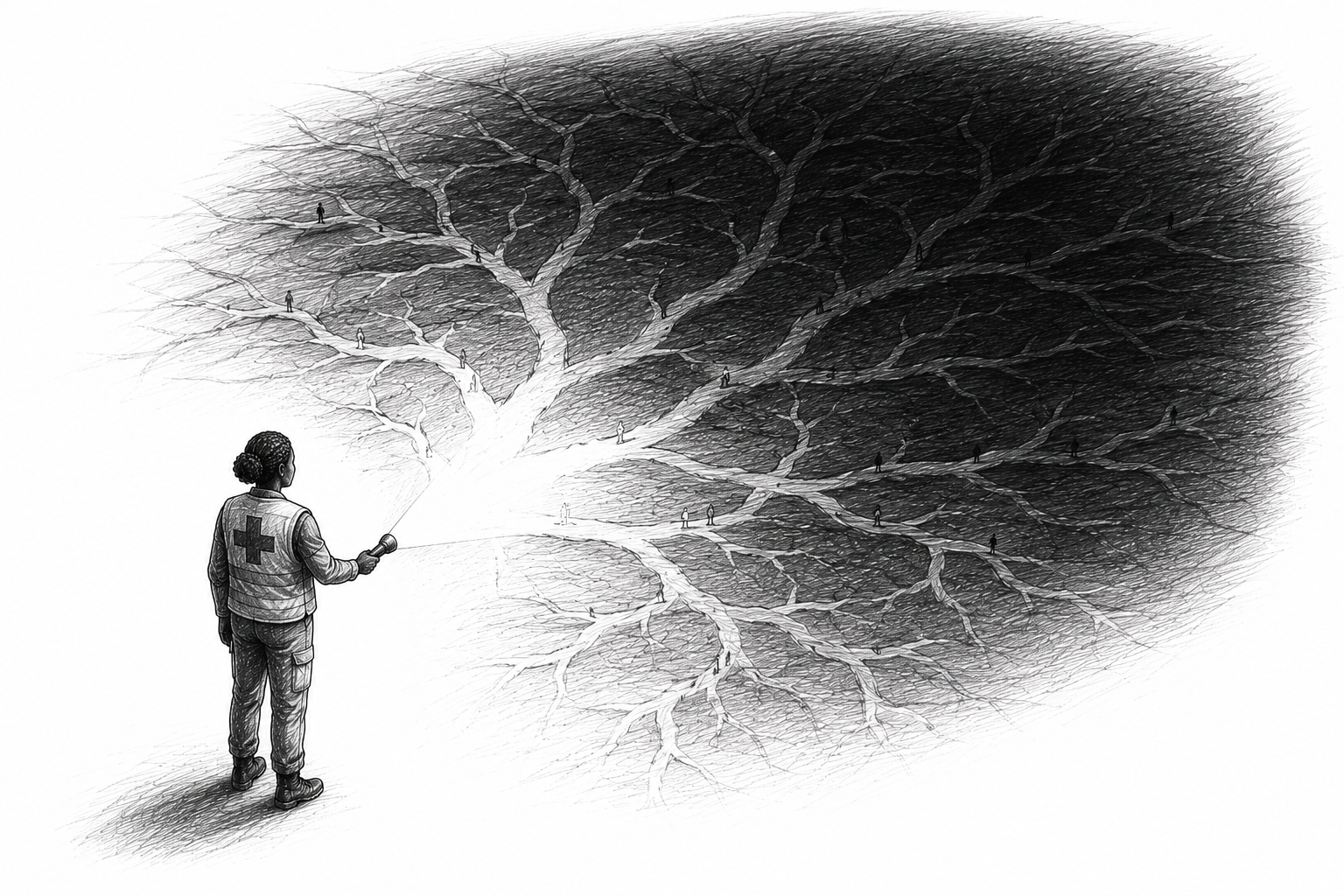
The contact tracing number is the sharpest indicator of how far the response still has to go. Only 45 percent of confirmed contacts have been followed up. WHO’s own threshold for staying ahead of an Ebola outbreak is above 90 percent. At 45 percent, the response is not containing the outbreak. It is documenting it. Every untraced contact is a potential transmission chain that the surveillance system cannot see. The gap between 45 percent and 90 percent is not a staffing footnote. It is the distance between response and control.
The funding picture contextualizes all of it. WHO needs at least $115 million over the next three months to mount an adequate response. As of Wednesday, approximately 35 percent of that figure has been raised. A broader fundraising effort with the Africa CDC and the DRC and Uganda governments launches Friday. The math is straightforward: the region most affected by this outbreak is negotiating for resources while the virus moves. Blanket travel restrictions imposed by other countries — framed as protective measures — are simultaneously disrupting the supply chains and personnel movements the response depends on. The countries least affected are making decisions that hamper the response in the countries absorbing the cost.
Six people have recovered in the DRC. Two have recovered in Uganda. WHO noted those recoveries as evidence that Ebola patients can survive with timely access to care. That framing carries its own structural weight. Survival is contingent on access. In a region where contact tracing covers less than half the known exposure network, where testing tools were mismatched to the strain, and where the funding required to close those gaps is still being assembled — access is exactly what is not guaranteed.
The DRC has been here before. The world has watched before. The pattern of delayed resource mobilization, reactive rather than preventive infrastructure investment, and travel-restriction politics that protect wealthier nations at the expense of outbreak response is not new. It is the operating condition. What is being called catching up is the response finally meeting a crisis that should never have been allowed this much runway.